A decade of architecture with a human purpose — a way back for people four systems failed at once. Sovereign by design, humane by intent: 94 primary Data Room instruments (GBS-aligned Index v3.0; 103+ including versions), attorney-ready IP, and the work begins now.
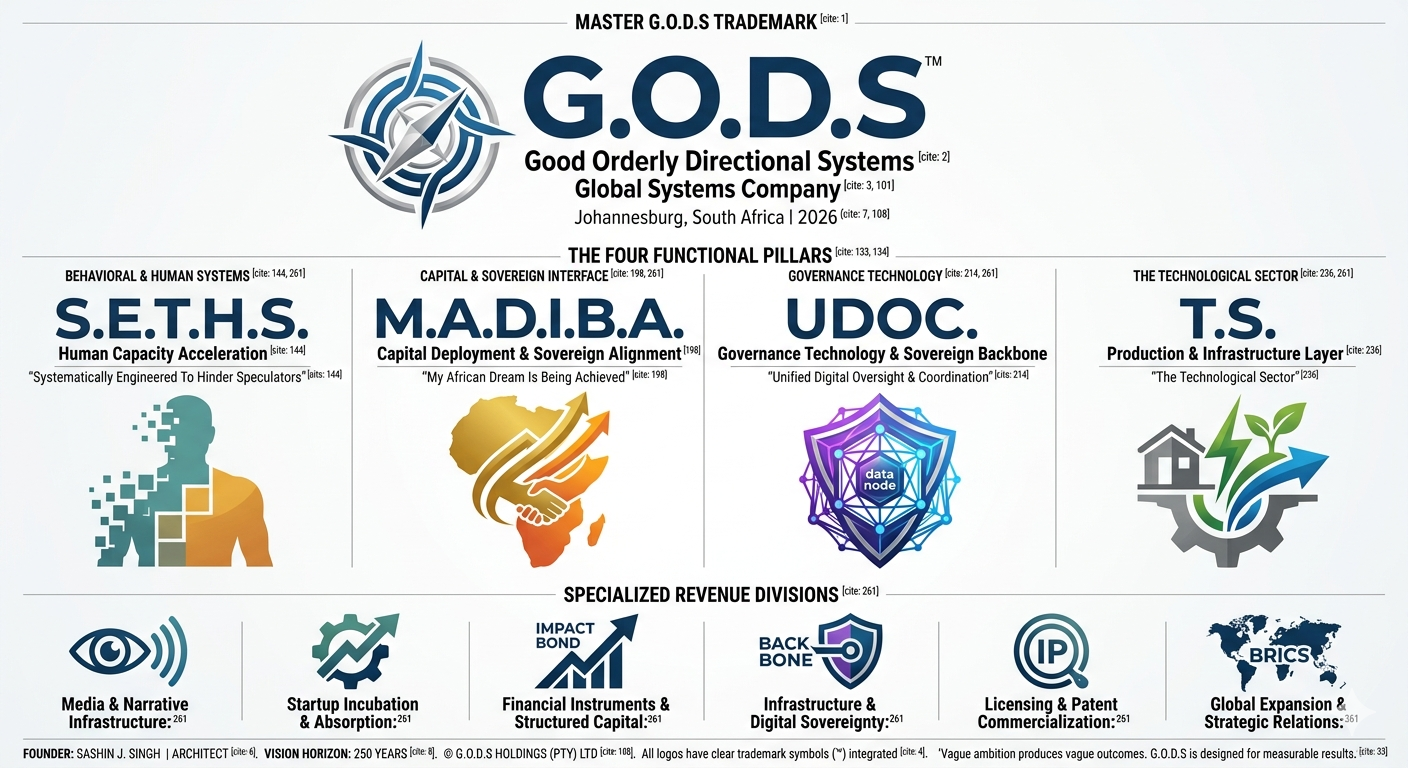
G.O.D.S began in 2016 as a self-help novel and a single observation: people who fall out of the formal economy are failed by four systems at once, and no single-domain solution can solve a multi-domain structural failure. What started as a workforce reintegration program became a four-division architecture: S.E.T.H.S → T.S Industries → UDOC → M.A.D.I.B.A. Ten years of original work — 2016 → 2026 — and ready to be built.
South Africa has watched two decades of programmes — government, NGO, corporate CSI, private skills development — attack pieces of the problem in isolation. Unemployment programmes without infrastructure to employ the trained workers. Infrastructure programmes without the trained workforce to build them. AI governance without sovereign capacity to enforce it. Capital architecture without proven deployment vehicles. Each piece failed not because the people were unable, but because no system connected them.
G.O.D.S exists because that fragmentation is the actual problem. The 12 Constitutional Pillars, the COB veto authority, the IP Trust, the four-division compounding loop — these are not aspirational features. They are the structural safeguards that prevent G.O.D.S from collapsing in the same way every previous attempt has collapsed: mission drift under commercial pressure, investor capture, founder concentration, governance erosion, scale without integrity. This is the difference between building a company and building an institution.
A self-help novel written by the Founder as personal recovery work. The book documented the structural collapse of dignity that addiction, incarceration, and long-term unemployment produce — and the structural void in society's response. The recurring observation: compassion gets people clean; systems keep them employed. Compassion is everywhere. Systems are nowhere. That gap became the seed of everything that followed.
The first formalised concept built from the novel. Named SETHS Empire, structured originally with two operating divisions: a Sales Division (commercial revenue engine) and a Service Division (delivery and physical infrastructure operations). The Service Division concept — multi-sector physical production employing trained graduates — became the architectural template that is now T.S Industries. The empowerment programme inside SETHS Empire became the methodology that is now S.E.T.H.S.
The realisation that workforce reintegration failure is a symptom — not the disease. People who cannot reintegrate are failed by four systems simultaneously: welfare that doesn't invest, justice that doesn't prepare, education that has written them off, labour markets without a pathway. A single-domain solution cannot solve a multi-domain structural failure. The four-division loop emerged from following the problem honestly to its structural roots: workforce (S.E.T.H.S.) → infrastructure (T.S., evolved from SETHS Empire's Service Division) → governance (UDOC) → capital (M.A.D.I.B.A.).
94 primary Data Room instruments (103+ with versions). 12 Constitutional Pillars. IP Trust deed drafted. COB charter complete. POPIA framework complete (May 2026). M.A.D.I.B.A. Mandate authored for The Presidency. 24 patent claim families authored and attorney-ready for CIPC + PCT filing (not yet filed). Multi-framework compliance engine designed against POPIA, EU AI Act, NIST AI RMF, ISO/IEC 42001, SA NAIFP (Aug 2024) [GG 54477 withdrawn]. The architecture is done. The work begins now.
"The closed compounding loop was not designed top-down. It emerged from following one problem honestly across a decade — through a self-help novel, through a first-attempt empire, through abandoned drafts — until the architecture revealed itself."
— Sashin J. Singh · Founder Doctrine & Origin Paper · 10 Years of Original WorkSouth Africa is not chosen by default. It's chosen because it sits at a unique intersection of every structural condition G.O.D.S is designed to solve. The numbers are not abstractions. They are daily reality:
These crises are not isolated. They compound. Unemployment drives crime and incarceration, which drives social welfare dependency, which reduces fiscal capacity, which reduces infrastructure investment, which reduces employment. Breaking this cycle requires an integrated system — not three more separate programmes.
UDOC is the commercial engine that funds the rest of G.O.D.S. A Consolidated Patent & IP Protection Instrument (v9.3 May 2026) has been authored — 4 core patent applications + 20 alternative embodiments (24 total patent claim families), ready for immediate CIPC provisional filing and PCT international filing. The platform simultaneously enforces compliance against POPIA · EU AI Act 2024 · NIST AI RMF · ISO/IEC 42001:2023 · SA NAIFP (Aug 2024) [GG 54477 draft withdrawn 26 Apr 2026]. The EVA engine and its mandatory irreversible Risk-Block mechanism are novel and patentable under SA Patents Act, PCT, and USPTO standards.
G.O.D.S is pre-registration. Before capital is raised, skilled professionals across 8 categories — Governance, Executive, Brand, S.E.T.H.S, UDOC, T.S, M.A.D.I.B.A, Board — are invited to pledge their expertise. The pledge register is the proof-of-concept that unlocks DFI capital. Your signature is an asset.
GBS is the July 2026 unifying doctrine and franchise-governance layer that sits above the four divisions. It is not a religion or ideology. It is the 80% constitutional core (Twelve Pillars, CET/CTE methodology, Skills Passport, Phase 6 lifetime re-entry) that never moves, paired with a 20% localisation allowance so a licensed node can adapt language, vocational pathways, and regulatory wrapper to its jurisdiction. G.O.D.S. is the institution; GBS is the standard the institution’s franchise operates under. Full definition: The G.O.D.S. Canon and GBS-SETHS Consolidated Super Framework v3.0 (Data Room Section H / I).
Capstone backend: gods-platform-core.onrender.com · 72 routes · Neon Postgres · GIS/EVA/CET-CTE in production.
Systematically Engineered To Hinder Speculators (also: Transfer of Human Systems — see Canon). 36-week programme, 5 phases, 5 employment streams. Converts structural unemployment, addiction recovery, and post-incarceration into verified, placed, retained employment. Direct workforce pipeline to T.S. Industries. POPIA-compliant, SETA-aligned. Programme design complete. Pilot: 50 participants in Gauteng.
Unified Digital Oversight & Coordination. Deterministic governance infrastructure with multi-plane architecture. NIST PQC-ready cryptographic substrate. Tamper-evident audit chain. Zero foreign cloud dependency. Africa's only constitutionally-governed AI oversight infrastructure. Enterprise ACV: R3M–R7M. v9.3 IP instrument attorney-ready. Capstone backend live (72 routes). Commercial platform begins at seed close.
The Technological Sector. 7 subsidiaries: Energy, Construction, AgriTech, Water, Digital Infrastructure, Manufacturing, Logistics. SPV co-ownership with government (20–60% equity). Primary employer for S.E.T.H.S. graduates. All 7 subsidiaries planned. No CIDB grading. Activation begins Year 1 post-seed.
My African Dream Is Being Achieved. Seed (R12–18M) → Series A via TS Holdings (R30–60M) → Infrastructure Fund I (R2B) → Fund II (R10B). FSCA FSP licence required Month 3. Target LPs: PIC, GEPF, AfDB, IFC. No capital raised. No licence held. Planning stage only.
"The loop cannot be entered from the side. Each division must be built simultaneously. G.O.D.S. will have 8–12 years of operational proof, government relationships, and institutional credibility that cannot be purchased."
— Sashin J. Singh, Founder & ArchitectEvery number in the columns below is from a named institutional source published between October 2025 and April 2026. No projections yet. Just the documented present.
From here, two paths. The "Without" column extrapolates the baseline above using the same institutions' own forward forecasts. The "With G.O.D.S" column shows the conservative additive impact of executing the architecture from Year 1 — taken from the G.O.D.S Comprehensive Business Plan 2026 base case, not the accelerated case.
"The difference between these two futures is not a question of ambition. It is a question of institutional discipline applied early enough to compound. Every year G.O.D.S is not built, the institutional baseline widens. Every year it operates, the baseline closes."
— Comprehensive Business Plan 2026 · Closing Thesis
| Class | Entry | Target Return | Mechanism | Liquidity |
|---|---|---|---|---|
| Seed / DFI | Phase 1 | 1.5–2× concessional | Impact-adjusted; government co-funding | DBSA/IDC exit at Phase 3 |
| Series A — Growth Equity | Phase 2 | 5–8× over 7 years | UDOC + T.S dividend; partial secondary | Secondary at Phase 3 · IPO Phase 5 |
| Infrastructure Finance (T.S) | Phase 2–3 | 8–12% IRR | SPV distributions; government offtake | SPV buyout · infrastructure bonds |
| Sovereign Fund (M.A.D.I.B.A) | Phase 3–4 | Market + 2% | Fund distributions; quantum premium | 20-year sovereign hold horizon |
| Strategic Partner | Phase 2+ | Negotiated per partner | Revenue sharing; preferred UDOC access | Strategic exit · IPO participation |
| Year | Conservative | Base Case | Accelerated | Operational Proof |
|---|---|---|---|---|
| Year 1 | R5.7M | R12M | R18M | 50 participants · 3 UDOC clients · 1 MOU |
| Year 3 | R55M | R78M | R120M | 500 participants · 5 projects · 12 UDOC clients |
| Year 5 | R280M | R450M | R750M | 2,500 participants · 3 SADC · QPU live |
| Year 10 | R1.8B | R3.5B | R6.2B | 25,000 participants · 10 SADC · 100 UDOC govts |
| Year 15 | R5.2B | R11B | R22B | 80,000 participants · continental · 250 UDOC |
| Year 25 | R25B | R60B | R140B | 500,000 participants · 1B people governed · global standard |
G.O.D.S draws from four institutional comparables. None independently does what G.O.D.S does, but each demonstrates the operational viability of one architectural dimension:
Direct alignment with South Africa's National Development Plan 2030. The M.A.D.I.B.A. Mandate (My African Dream Is Being Achieved) is positioned as the primary private execution engine for NDP 2030 delivery — a state-aligned, privately-executed strategic plan that translates national policy into measurable outcomes through commercial structures with constitutional protections.
Engagement targets: The Presidency · National Treasury · DPSA · DCDT · DSD · DoL · Provincial Premiers
South Africa is the SADC headquarters jurisdiction for most multinationals operating in Africa. A successful Gauteng pilot creates the replication case for 14 SADC nations directly. By Year 5, M.A.D.I.B.A engages AfDB Private Sector Department for cornerstone LP commitment in the R2bn Infrastructure Fund I. By Year 25, UDOC is referenced by AU Commission policy in continental AI governance.
Engagement targets: AfDB · AU Commission · SADC Secretariat · Rwanda Vision 2050 · Kenya BPO sector · Ghana fintech
The pledge register changes the DFI conversation before capital is raised. When a DBSA committee reviewing a seed application sees signed pledges from senior legal professionals, board-calibre INED nominees, and retired DFI executives — the risk conversation shifts entirely. The pledge list is the primary credibility instrument for DFI engagement.
Engagement targets: DBSA · IDC · PIC · GEPF · AfDB · IFC · DFC · BII · Norfund · CDC · KfW DEG · Proparco
UDOC's Jurisdiction-Bound Enforcement Architecture (AEEF) is anchored to verifiable instruments: SA Constitution, POPIA, EU AI Act, NIST AI RMF, ISO/IEC 42001, Singapore Agentic AI Framework. The platform is positioned as the technical nerve-centre for South Africa's multi-regulator model — providing the Regulator Portal and Case Rooms where ICASA, the Information Regulator, and the FSCA coordinate oversight.
Engagement targets: DCDT · Information Regulator · ICASA · FSCA · CSIR · SABS · academic AI ethics centres
Legal Expert · Technology Ethicist · Community Representative · International Institutional · Independent Financial Expert. Binding halt authority (3/5 majority). Founder removal (unanimous 5/5 with documented Pillar violations). Annual compliance certificate — material for all government contracts. Recruitment begins before any external capital is accepted.
| Stream | Skills | Employer Destination |
|---|---|---|
| A — Construction/Solar | Solar PV, CIDB, OHSA | T.S. Energy + T.S. Construction |
| B — Digital Operations | MS Office, data, admin | Corporate, BPO, G.O.D.S. internal |
| C — Agriculture/Food | Hydroponics, CEA, food safety | T.S. AgriTech (primary) |
| D — Community Health | CHW scope, ECD, social support | NDoH CHW, NGOs, hospitals |
| E — Logistics | PDP, forklift, cold chain | T.S. Logistics, FMCG |
UDOC's cryptographic substrate is built on the NIST-finalised FIPS 203–206 post-quantum family. Specific algorithm pairings, the key hierarchy, hybrid TLS configurations, and the integration with the immutable audit chain constitute protected IP under the v9.3 instrument — released only to qualified investors and technical partners under signed NDA.
Solar PV EPC, battery storage, REIPP programme. Workforce: Stream A graduates. Year 1 activation.
Modular social housing — target 40–60% cost reduction. 3.7M unit SA backlog addressable. Year 1.
Vertical farming, container farms, hydroponics. Food security municipalities. Stream C. Year 2.
NRW reduction, smart metering, municipal rehab. SANS 10252 compliant. Year 2.
Sovereign cloud data centres. UDOC hosting. POPIA-compliant govt data. Year 2–3.
Modular building panels, local solar mounting. 40%+ local content for govt tenders. Year 3–5.
Last-mile delivery, cold chain, logistics SaaS. Stream E graduates as primary workforce. Year 3–5.
No registrations. No CIDB grading. No projects awarded. Activation: Yr 1 Energy+Construction → Yr 2 Agri+Water → Yr 3+ Digital+Mfg+Logistics
DFI grants + angel. IDC Social Grant, DBSA, National Treasury SEF applications submitted. Core team, UDOC MVP, S.E.T.H.S. pilot. No capital raised.
Month 18–24. Class B shares. 4 mandatory proof triggers all required before data room opens. Target: IDC or DBSA anchor. Return: 5–8× over 7 years.
Fund I: 10-year term, 12–16% net IRR. Target LPs: PIC, GEPF, AfDB, IFC. FSCA FSP licence required. Fund II: continental, Year 5+.
| Division | Year 1 | Year 2 | Year 3 | Year 5 | Margin (mature) |
|---|---|---|---|---|---|
| S.E.T.H.S. | R3.95M | R8.6M | R16M | R52M | ~70% |
| UDOC | R2.2M | R6.5M | R17.5M | R110M | 75–85% |
| T.S. Industries | R0 | R9M | R21.5M | R102M | ~42% |
| M.A.D.I.B.A | R800K | R3.1M | R9M | R46M | ~78% |
| Total | R6.95M | R27.2M | R64M | R310M | avg 65% |
| Class | Votes | Holder |
|---|---|---|
| A — Governance | 10/share | IP Trust only · Cannot be sold |
| B — Investor | 1/share | Institutional investors |
| C — Strategic | 1 restricted | Govt / sovereign funds |
| D — Employee | None | Staff + S.E.T.H.S. alumni 3yr+ |
The complete working archive is embedded directly in this site — every draft, every version, exactly as authored. 103 documents across 7 sections (A–G) · 102 download directly with no restrictions · 1 withheld (the patent instrument, founder-held). Includes the full manifesto set, business plan, financial model, all UDOC technical whitepapers and hardware specs, S.E.T.H.S programme, legal templates, pitch decks, brand manual, and research papers.
No NDA. No tiers. No request forms. Everything downloads directly — this is a concept, openly shared. Only the patent instrument is withheld. Contact: sashin.singh@outlook.com
Founder: Sashin J. Singh · Johannesburg, South Africa · sashin.singh@outlook.com
"Built for generations — not quarters." · Pre-launch: zero registrations, zero funding, zero business acquired · All architecture complete and ready for seed capital deployment.
| Competitor Type | What They Lack | Replication Time |
|---|---|---|
| Palantir / IBM Watson | Africa sovereignty, constitutional governance, S.E.T.H.S. workforce | Cannot by design |
| EPC firms (Murray & Roberts) | Human capital pipeline, AI governance, capital architecture | 8–12 years |
| DFIs (DBSA, AfDB) | Execution infrastructure, workforce pipeline, compounding loop | Not their mandate |
| Workforce NGOs (NICRO) | Not commercially structured — no T.S., no UDOC, no capital | 8–12 years |
| Any single competitor | 8–12 years minimum | |
For ten years people asked me for a "pitch deck" when I handed them a business plan. Isn't a business plan a pitch — of decked-out ideas, laid out on paper? Apparently not. Apparently the global solution to compounding world problems is meant to compress into five minutes and twelve slides because that is the attention span the room can offer.
It doesn't. A real plan happens over years, not minutes. So below is the pitch deck — the decked-out ideas in the form the room expects — because the room rules, not me. Read it in the order designed. Then read the business plan if you actually want the depth.
I'm still laughing at the request, by the way. But here you go.
S.E.T.H.S. is not a charity programme — it is a human-capital development system built on five operational pillars that are commercially required: they are what makes employer confidence possible, what makes S.E.T.H.S. certification meaningful, and what differentiates this from every NGO rehabilitation programme that came before. The pillars originate in the Founder's Confessions of an Addict recovery work (2016) and were structurally refined through SETHS Empire (2017–2022) before reaching their current institutional form.
"Honesty is what makes employer confidence possible. Without it, S.E.T.H.S. certification means nothing."
Radical structured honesty applied symmetrically — by participants AND by the institution. Participants are honest about relapse risk and behavioural history. Facilitators are honest about programme limitations. Performance data is auditable. No employer hires a S.E.T.H.S. graduate without the assurance that the data on that graduate is the data.
"A relapse triggers a documented proportionate response, not permanent disqualification. People who are failing forward are not the same as people who are giving up."
Structured tolerance of the recovery process — not of destructive behaviour. Every previous workforce reintegration programme has either zero-tolerance (cruelty disguised as discipline) or unlimited-tolerance (no discipline at all). Both fail. S.E.T.H.S. defines a third path: structured tolerance. A relapse triggers a documented proportionate response — clinical intervention, schedule adjustment, mentor matching escalation — but not removal from the programme.
"Spiritual anchors are real recovery infrastructure. Imposing or denying them is the same failure."
Freedom of faith without imposition. Spiritual anchors — Christian, Muslim, Hindu, traditional African, secular, atheist, anything — are respected as dimensions of human dignity and operational recovery resources. S.E.T.H.S. does not impose belief and does not exclude belief. This is what makes the system scalable across every cultural context in South Africa and across the African continent.
"Consistency of standards is what makes S.E.T.H.S. certification a credential that employers will pay for."
Equal access, equal accountability, equal measurement. Every participant is assessed against the same standard. Every facilitator delivers the same curriculum. Every employer receives the same certification quality. Consistency of standards is the commercial guarantee that makes S.E.T.H.S. certification meaningful to employers — and is the reason the programme can scale from 50 participants to 500,000 without quality collapse.
"People protect what gives them dignity. Restoration of pride is how lasting change actually happens."
Restoration of pride is the most durable behavioural intervention S.E.T.H.S. delivers. Every other intervention — clinical treatment, skills training, employment placement — works because, and only because, it restores a participant's sense of dignity, contribution, and self-respect. People protect what gives them dignity. This is the mechanism through which lasting change occurs. It is also the reason S.E.T.H.S. retention rates can credibly target 70% at 12 months while industry comparables sit at 30–40%.
Honesty + Tolerance + Belief Systems + Equality + Pride are not arbitrary virtues. They are the five structural conditions under which a workforce reintegration programme can be commercially defensible at scale. Every pillar maps to a specific commercial requirement: Honesty enables employer trust. Tolerance enables retention. Belief Systems enables continental scalability. Equality enables certification value. Pride enables long-term retention. Remove any one and the commercial proposition collapses. This is what 10 years of refinement produced — not a list of values, but a structural commercial machine wearing the language of dignity.
Skills: Solar PV installation (MQA/EWSETA), CIDB Grade 1–3, OHSA General Safety, first aid, tool use, site safety.
Qualification: NQF Level 2 Construction.
Primary employer: T.S. Energy + T.S. Construction.
Prerequisite: Physical fitness assessment + basic numeracy test.
Skills: MS Office 365, data entry, bookkeeping fundamentals, CRM systems, POPIA data handler training.
Qualification: NQF Level 3 Business Administration.
Primary employer: Corporate, BPO, G.O.D.S. internal divisions.
Skills: Hydroponics, controlled environment agriculture (CEA), vertical farming systems, food safety (HACCP), nutrient management.
Qualification: AgriSETA Unit Standards.
Primary employer: T.S. AgriTech.
Skills: CHW scope of practice, basic health assessment, ECD fundamentals, social support referral, home-based care.
Qualification: HWSETA CHW NQF Level 2.
Primary employer: NDoH CHW programme, NGOs, Netcare community clinics.
Skills: Professional Driver Permit (PDP), forklift certification, WMS software, cold chain logistics.
Qualification: TETA unit standards.
Primary employer: T.S. Logistics, FMCG.
Activation: Month 6+ after Cohort 1 placement confirmed.
| Programme Manager | R480K |
| 3× Case Managers | R720K |
| Stipends (50 participants) | R600K |
| Stream trainer contracts | R840K |
| Facility lease (SDU) | R480K |
| Assessment & materials | R240K |
| Total Year 1 | R3.36M |
Detailed technical schemas, opcodes, state machine specifications, hardware enforcement mechanisms, and cryptographic implementation details are not disclosed publicly — they are protected under the v9.3 IP instrument and released only to qualified investors and technical partners under signed NDA + counsel review.
UDOC is architected to use NIST-finalised post-quantum cryptographic algorithms (FIPS 203–206 family) as the cryptographic substrate for all governance operations. Specific algorithm pairings, key hierarchies, hybrid TLS configurations, and integration with the immutable audit chain are protected under the v9.3 IP instrument and released only to qualified investors and technical partners under NDA.
Why this matters commercially: Every enterprise and government client deploying UDOC inherits PQC-readiness from Day 1, eliminating the multi-year, multi-million-rand "quantum migration" projects that Palantir, IBM, Microsoft, AWS, and Azure clients will face starting 2027 as NIST deadlines tighten. UDOC clients are already on the standard before competitors begin migrating.
| Tier | ACV Target | Client Type |
|---|---|---|
| Enterprise SaaS | R3M–R7M | Large corp, financial institutions |
| Government Backbone | R8M–R25M | National/provincial government |
| SADC Sovereign | R15M–R50M | African government ministries |
| Implementation fee | R500K–R2M | One-time onboarding |
UDOC is the technical mechanism for Pillar VIII. Every AI model deployed across G.O.D.S. and client systems must be registered in the AI Registry. Three-method bias detection runs continuously. No consequential AI decision executes without a human-authorised override pathway. All decisions Merkle-audited. Independently verifiable by regulators through the read-only regulator portal. This is not a feature — it is the core architectural mandate.
Solar PV EPC + battery storage. REIPP programme. CIDB 7EP + 5ME planned. Stream A graduates. Year 1.
Modular prefab housing. Target: −40–60% unit cost. NHBRC + CIDB 5GB planned. DHS pipeline. Year 1.
20ft container farms, hydroponics, CEA. Municipal food security. Stream C. Year 2 activation.
NRW reduction, smart metering, infrastructure rehab. Municipal retainers. SANS 10252. Year 2.
Sovereign cloud data centres. UDOC hosting. POPIA-compliant govt data. National Key Point planning. Year 2–3.
Modular building panels, solar mounting hardware. 40%+ local content for govt tenders. Year 3–5.
Last-mile delivery, cold chain, logistics SaaS platform. Stream E graduates as primary workforce. Year 3–5.
Year 1: Energy + Construction
Year 2: AgriTech + Water
Year 2–3: Digital Infra
Year 3–5: Manufacturing + Logistics
| Project Type | T.S. | Govt | M.A.D.I.B.A Fund | Revenue |
|---|---|---|---|---|
| REIPP Energy | 51% | 20% | 29% | 20-year PPA |
| Social Housing | 45% | 35% | 20% | DHS contract |
| Water Rehabilitation | 40% | 60% | — | Municipal retainer |
| Sovereign Cloud (UDOC) | 51% | 49% | — | Platform + licence |
S.E.T.H.S. recruits from communities where T.S. will build → trains for T.S. workforce → places graduates into T.S. projects → project completion generates revenue → revenue funds next cohort. UDOC tracks every placement through every project milestone. M.A.D.I.B.A capital flows to proven T.S. SPVs.
| Year 5 revenue | R102M |
| Gross margin | ~42% |
| Active SPVs | 6–10 |
| S.E.T.H.S. workers deployed | 500+ |
| Sources | IDC social grant, DBSA, NT SEF, angel |
| Timeline | Months 1–6 |
| Use | Team, legal, S.E.T.H.S. pilot, UDOC MVP |
| Return target | 1.5–2× concessional + impact |
| Entity | G.O.D.S. TS Holdings (Pty) Ltd |
| Timing | Month 18–24 (proof-triggered) |
| Share class | Class B — Investor Shares |
| Trigger | All 4 Stage One conditions met |
| Target return | 5–8× over 7 years |
| Fund I size | R2B target · SA + SADC focus |
| Fund I term | 10 years + 2yr extension |
| Management fee | 1.5% committed capital |
| Carried interest | 20% over 8% hurdle |
| Target net IRR | 12–16% |
| Target LPs | PIC, GEPF, AfDB, IFC, sovereign |
M.A.D.I.B.A. credibility is built from T.S. operational proof, verified through UDOC, anchored by government co-investment. The proof chain: government co-owns T.S. SPVs → government uses UDOC backbone → government LOI → institutional LPs treat SA government co-investment as de-risk signal for Fund I commitments.
"We raise capital on proof, not on projections. No data room opens until all four Stage One triggers are met. This is constitutional, not aspirational."
— M.A.D.I.B.A Capital Strategy, Constitutional CommitmentMy African Dream Is Being Achieved is positioned not merely as a capital strategy but as a comprehensive state-funded, privately executed national strategic plan — proposing a structural partnership between the Republic of South Africa and G.O.D.S Holdings to serve as the primary delivery engine for the National Development Plan 2030, while building the groundwork for a prosperous, equitable, globally competitive nation by 2050.
Source: M.A.D.I.B.A. × G.O.D.S. Earth Legacy — Master Implementation Plan 2025–2050 (Confidential — Founding Stakeholders, Strategic Partners & Investors)
S.E.T.H.S pilot proves the methodology. UDOC enters enterprise market. T.S delivers first SPV projects. M.A.D.I.B.A. Fund I closes at R2bn. Direct alignment with NDP 2030 employment, energy transition, and digital sovereignty targets.
S.E.T.H.S placements reach 80,000 cumulative. UDOC adopted by 100+ government departments continentally. T.S delivers infrastructure at national scale. M.A.D.I.B.A. Fund II at R10bn. Continental policy influence via AU.
500,000+ cumulative S.E.T.H.S placements. UDOC referenced in AU Commission AI governance policy. T.S delivers continental energy and housing infrastructure. M.A.D.I.B.A. ranks among Africa's premier sovereign-aligned infrastructure managers.
| Ubuntu in Operations | Every task and project must generate communal value, not only commercial return. Constitutional Pillar I (Human Dignity) enforced at programme level. |
| Agile Governance | 6-month review cycles tied to IEOC (Independent Executive Oversight Committee) oversight. Course correction is structural, not exceptional. |
| Transparency & Accountability | Quarterly public reporting. Independent audit annually. Constitutional Oversight Board reviews all material decisions against the 12 Pillars. |
| Sovereign Respect | State partnership, not state replacement. All work executed within and in support of national legal frameworks. No parallel governance structures. |
| Long-Horizon Discipline | Every material decision evaluated for consequences in 10, 25, and 100 years. Quarterly profit optimisation explicitly subordinated to long-term institutional integrity. |
The Mandate Document Status: A formal presidential briefing document ("The M.A.D.I.B.A. Mandate — A Legacy Initiative to Realize the NDP 2030 and Propel South Africa to Global Leadership by 2050") has been authored as the institutional engagement instrument for The Presidency, National Treasury, and provincial leadership. Not yet submitted. Submission is sequenced to follow Stage One operational proof (audited outcome data from the 50-participant S.E.T.H.S pilot) — consistent with the Constitutional Pillar XII (Evidence-Driven) requirement that institutional credibility be earned through documented outcomes, not asserted in advance.
"We do not seek a meeting with the Presidency to ask for a vision. We will seek that meeting to deliver a system that already works — and to invite the state into structured co-ownership of its national-scale expansion."
— M.A.D.I.B.A. Mandate · Institutional Engagement Doctrine| Division | Year 1 | Year 2 | Year 3 | Year 5 | Margin Y5 |
|---|---|---|---|---|---|
| S.E.T.H.S. | R3.95M | R8.6M | R16M | R52M | ~70% |
| UDOC | R2.2M | R6.5M | R17.5M | R110M | 75–85% |
| T.S. | R0 | R9M | R21.5M | R102M | ~42% |
| M.A.D.I.B.A | R800K | R3.1M | R9M | R46M | ~78% |
| Total | R6.95M | R27.2M | R64M | R310M | avg 65% |
| Operating costs | R13.5M | R22M | R38M | R130M | — |
| EBITDA | (R6.5M) | +R5.2M | +R26M | +R180M | 58% |
| Year | Lean (×0.8) | Base (×1.0) | Optimistic (×1.35) |
|---|---|---|---|
| Year 1 | R5.6M | R6.95M | R9.4M |
| Year 3 | R51.2M | R64M | R86.4M |
| Year 5 | R248M | R310M | R418.5M |
| Year 10 | R1.8B | R3.5B | R4.7B |
| Year 25 | R25B | R60B | R81B |
| Scenario | Year 1 | 24-Month | 60-Month |
|---|---|---|---|
| Lean (×0.8) | R65.6M | R103.9M | R215.9M |
| Base (×1.0) | R82M | R129.9M | R269.9M |
| Expanded (×1.35) | R110.7M | R175.3M | R364.4M |
Parties: G.O.D.S Holdings (Pty) Ltd + Disclosing Party (mutual).
Scope: Strategic plans, financial projections, technical architectures, constitutional governance structures, personnel information, client lists, UDOC architecture, S.E.T.H.S. programme design, M.A.D.I.B.A. financial models.
Term: 2 years from execution + indefinite for trade secrets.
Governing law: Republic of South Africa. Disputes: AFSA arbitration (Cape Town).
Key provisions: Broad CI definition. Permitted: legal obligation + prior written consent. No reverse engineering of UDOC architecture. No poaching of G.O.D.S. personnel for 24 months post-disclosure.
Status: Draft — requires attorney review and entity registration before execution.
Parties: G.O.D.S Holdings (Pty) Ltd + Government Entity.
Purpose: Non-binding framework for collaboration on S.E.T.H.S. pipeline, UDOC digital governance, T.S. infrastructure co-investment.
Key clauses: Voluntary participation (Pillar III). No exclusivity. Annual review mechanism. POPIA data sharing protocol. IP stays in G.O.D.S. IP Trust. Exit without penalty.
UDOC clause: All joint data processed through UDOC sovereign infrastructure. Government retains data sovereignty. Data never leaves SA jurisdiction.
Status: Draft — requires government legal team review. Not binding until signed by authorised signatories.
Parties: S.E.T.H.S. (Pty) Ltd + Employer Partner.
S.E.T.H.S. obligations: Pre-screened, trained candidates matching stream profile. Pre-employment assessment. 6-month post-placement case manager support. SETA documentation.
Employer obligations: 90-day trial minimum. BCEA-compliant wages. UDOC attendance reporting. 30/60/90-day outcome data to UDOC.
Protection clauses: Employer cannot poach other S.E.T.H.S. graduates for 12 months. Non-circumvention: cannot bypass S.E.T.H.S. to recruit direct from programme.
Status: Draft — attorney review required.
Parties: UDOC Technologies (Pty) Ltd + Client Organisation.
Pilot term: 90 days at R250K (credited against Year 1 ACV if client proceeds).
Data sovereignty: Client retains all rights. UDOC cannot access, share, or analyse client data without explicit written authorisation. Master keys in client HSM.
PQC commitment: UDOC warrants NIST-finalised post-quantum cryptographic algorithms active from Day 1.
Audit rights: Client may request Merkle audit log for any 30-day period on 5 business days notice.
Exit clause: Terminate with 30 days notice. All client data deleted from UDOC infrastructure within 10 business days.
Status: Draft — attorney review required before any client engagement.
| Action | Timeline | Cost | Consequence if Missed |
|---|---|---|---|
| CIPC — 5 registrations | Day 1 | R625 | No legal standing. Cannot sign contracts. |
| Beneficial Ownership | Day 1–10 | R0 | Criminal offence under Companies Act. |
| IP Trust — Master of High Court | Day 1 | R15K–R30K | IP unprotected. Class A shares unguarded. |
| Trademark — 5 marks (CIPRO) | Week 1 | R3,540 | Third-party squatting risk on all names. |
| POPIA Information Officer | Before data | R0 | R10M+ fine. Criminal liability. [POPIA Framework B-10/E-08 now complete] |
| POPIA Section 57 authorisation | Pre-intake | R0 | Cannot process criminal records legally. |
| Custom MOI (Holdings) | Month 1 | R30K–R60K | Standard MOI = no constitutional protection. |
| FSCA FSP Cat I+II | Month 3 | R50K–R150K | Cannot operate M.A.D.I.B.A. funds. |
The Problem G.O.D.S. Solves for Government:
Government faces three simultaneous crises that current procurement cannot address: 43.1% expanded unemployment with no structured reintegration system; sovereign data under foreign jurisdiction with no Africa-domiciled alternative; infrastructure delivery at 10% of required rate with no execution engine willing to co-own outcomes with the state.
What Government Receives:
What Government Does Not Give Up:
"Government is a co-owner, not a client. Co-owners have skin in the game. That changes everything."
— G.O.D.S. Government Partnership FrameworkThe Investment Thesis:
G.O.D.S. is not a startup betting on a hypothesis. It is an institution building proof before asking for scale capital. No Series A data room opens until all four operational triggers are met — independently verified through UDOC. Investors buy into proven outcomes, not projected narratives.
| Return Driver | Mechanism | Timeline |
|---|---|---|
| UDOC SaaS | 75–85% gross margin | Year 1+ |
| T.S. SPV distributions | 20-yr PPAs, DHS contracts | Year 3+ |
| M.A.D.I.B.A carry | 20% over 8% hurdle | Year 5+ |
| Series B secondary | Liquidity for Series A | Year 4–5 |
Investor Protections:
What UDOC Offers Technology Partners:
UDOC is an AI governance layer, not an AI replacement. Technology partners integrate their AI systems with UDOC to provide their clients with constitutionally-governed, post-quantum-secured, independently-auditable AI infrastructure — what no hyperscaler can offer: Africa-domiciled sovereignty with zero US CLOUD Act exposure.
Integration Options:
Technical Differentiators:
The Employer Proposition:
S.E.T.H.S. graduates are not unemployed people who attended a course. They are individuals who completed a 36-week trauma-informed, technically trained, employer-simulated pathway — with outcomes independently verified through UDOC. You know precisely what you are hiring before you interview.
What Employers Receive:
Cohort 1 Planning Targets:
| Metric | Target |
|---|---|
| Pre-placement assessment pass rate | 90%+ |
| Placement within 60 days of Phase 4 | 75%+ |
| 90-day retention | 70%+ |
| 6-month performance: satisfactory+ | 65%+ |
None of these targets achieved yet. They are design outcomes. Actual cohort data will be available through UDOC upon programme commencement.
A 10-step guided walk-through narrated by the founder. Each step auto-scrolls you to the relevant section and explains what you're looking at. ~6 minutes total. You can exit, pause, or skip ahead at any point.
Click any card to expand its detail. Each card is hand-written from 10 years of accumulated institutional architecture work.
| Seat | Profile | Status | Target |
|---|---|---|---|
| 1 | SA Attorney — AI/tech law, 10yr+ | Advertising | Month 2 |
| 2 | Technology Ethicist — PhD, AI ethics | Not started | Month 2 |
| 3 | Community Representative — civil society | Not started | Month 2 |
| 4 | International Institutional — UN/IFC/AfDB | Not started | Month 3 |
| 5 | Independent Financial Expert — CA(SA)/CFA | Advertising | Month 2 |
| Milestone | Month | Status |
|---|---|---|
| All 5 entities registered | 1 | Not started |
| Core team 19 FTE hired | 3 | Not started |
| S.E.T.H.S. facility secured | 3 | Not started |
| UDOC MVP build begun | 4 | Not started |
| S.E.T.H.S. cohort 1 intake | 7 | Not started |
| UDOC first enterprise client paying | 8 | Not started |
| T.S. first project commenced | 9 | Not started |
| 100+ S.E.T.H.S. placements verified | 18 | Not started |
| Series A data room opened | 18–24 | Not started |
G.O.D.S. Holdings (Pty) Ltd is a South African civilisation infrastructure company with a 250-year institutional mandate. Four commercially structured divisions form a closed compounding loop. Governed by a 5-seat independent COB, an IP Trust, and 12 Constitutional Pillars that cannot be overridden by any investor, executive, or shareholder vote. Not a movement or ideology — a company that delivers measurable outcomes, raises capital, employs talent, and builds infrastructure.
S.E.T.H.S. → T.S. (certified workforce) → government contract revenue. T.S. → operational proof → M.A.D.I.B.A capital raise. UDOC governs all divisions and clients → SaaS revenue → independent verification of every outcome. M.A.D.I.B.A raises on verified proof → deploys to T.S. SPVs → funds more S.E.T.H.S. cohorts. No division is optional. The loop is the product.
IP Trust holds Class A shares — cannot be sold or wound up. COB has independent halt authority. Custom MOI embeds all 12 Pillars — amendment requires 75% IP Trust + 4/5 COB. Founder can be removed operationally by unanimous COB vote. This structure is not optics — it is the mechanism by which a 250-year institution survives individual failure, political change, and hostile acquisition attempts.
| Horizon | Revenue (Base) | EBITDA |
|---|---|---|
| Year 1 | R6.95M | (R6.5M) |
| Year 3 | R64M | +R26M (41%) |
| Year 5 | R310M | +R180M (58%) |
| Year 10 | R3.5B | +R2.1B (60%+) |
Seed: R12–18M (Month 1–6). Series A: R30–60M (Month 18–24, all 4 triggers required). Infrastructure Fund I: R2B (Year 2–3, FSCA licensed, 12–16% net IRR). Fund II: R10B (Year 5+, continental). No capital deployed to any stage that has not been operationally proven. This is constitutional, not aspirational.
Phase 1 (0–5yr): Structural proof. Phase 2 (5–25yr): National + SADC. Phase 3 (25–100yr): 25 countries, UDOC voluntary standard. Phase 4 (100–250yr): Institution self-governing, contribution-first systems embedded globally. The 250-year mandate prevents the short-termism that destroys all predecessors.
"I am building a system that should outlast me. That is not modesty — it is the minimum requirement for taking the problem seriously."
— Sashin J. Singh, Founder, G.O.D.S Holdings · sashin.singh@outlook.comG.O.D.S Holdings (Pty) Ltd · Johannesburg, South Africa · 250-Year Mandate
sashin.singh@outlook.com · WhatsApp Pledges: +27 79 411 6997 · Pre-launch institutional architecture · Not a securities offering
Two decades of work, a corporate spine I read from the inside, one published book, and one institution-in-waiting. Not a pitch. Not a marketing translation. The work, in the order it happened, in the words it deserves.
The Software Developer 118707 capstone, the deployed build you are inside right now, and the corporate exposure that produced both — those are documented, verifiable, and complete. That is the floor. The full 250-year Earth's Vision Plan, the public/private G.O.D.S Earth division, the Conscious Virtual Engager — those only begin if structured due diligence and committed pledge support arrive. Until then, this stays on the internet as documented proof that someone wrote it, in 2026, before the world was ready for it.
If nothing else happens after this, the work is documented. That is enough for me.
My first business plan was written when I was seventeen, waiting for matric results. A friend's father sat us down with a stack of business books and offered to pay us R100 each to draft something. To us it looked like a paid brief. To him — and I only understood this years later — it was a father's plan to keep his teenage son and his friends busy and out of trouble during the long wait. I took the brief seriously and ended up writing about 80% of the document myself.
My friend's father took the document. I took my own copy home and gave it to my father, who put it away with his things. Some months later, my father took a call from his board at the Reunert subsidiary where he worked — the JSE-listed industrial group whose businesses I would later study independently in detail. His friend, my friend's father, had pitched my plan to that board as his own work. They called my father to verify. He produced the copy I had left with him. The board read both, and sent a message back: tell your son there is a position waiting for him when he's done with his studies.
That was the first time I learned something I have needed every year since: people will routinely assume less of me than I am. The work has to do its own talking, and when it does, it travels further than I do. I didn't take the position. I went a different way. But the lesson stayed.
I do not hold a degree. I completed eleven of twelve first-year BBA modules while at Discovery and stopped after I exited. What I have instead is an unusually direct, badly compensated, often painful seminar in how South African financial-services architecture actually works — read from the inside, role by role. The companies are listed in sequence because each one taught me a specific structural lesson now wired into G.O.D.S. The research that follows is mine, done independently across these years, not delivered by anyone's curriculum.
Temporary contractor at Absa during the Barclays-majority era — Barclays held a controlling stake from 2005 and ran the group as a Barclays subsidiary until the 2018 reversion to Absa Group Limited. I was new and a regional manager asked me how I was finding the place. I told him I had concerns but I would only raise them once I was permanent. I was dismissed for it. Lesson: in large institutions, the timing of honesty is itself a tested skill. Too early, it reads as instability. Too late, it reads as opportunism. I mistimed it. I never mistimed it the same way again.
South Africa's largest mobile network operator, then moving into Vodafone majority ownership (Vodafone's stake reached roughly 65% in 2008). I was producing results and watching graduates with weaker outputs get advanced ahead of me. I resigned. Lesson: in scale operations driven by metrics and call-centre throughput, a top performer without an internal sponsor is functionally invisible to the people deciding who gets developed. Output without sponsorship doesn't convert. S.E.T.H.S addresses this by making sponsorship a designed-in mechanism rather than an accidental one.
Africa's largest bank by assets. A colleague — someone I considered a friend — approached me with a plan involving credit-card fraud. I refused. Out of friendship, and out of a naïve belief he would drop it once I'd said no clearly enough, I did not report him. I told him directly that what he was proposing was stupid and not to do it. He did it anyway, after hours, without my knowledge. I happened to come back to the building that same night because I had forgotten my house keys, and he was my lift home. We were both on CCTV. He was called in and confessed everything, including that I had refused. He was dismissed for the fraud. I was dismissed for the non-reporting.
I understood the call only later. The Financial Intelligence Centre Act 38 of 2001 creates affirmative reporting duties on banks — suspicious-and-unusual-transaction reporting, internal escalation obligations. The bank itself carries statutory exposure for what its staff fail to report. The scale of that exposure was made public again recently: in January 2025 the SARB Prudential Authority imposed a R13 million administrative sanction on Standard Bank after a 2022 inspection found tens of thousands of suspicious-transaction reports filed late, and tens of thousands of monitoring alerts not actioned within deadline. In an institution carrying that statutory weight, silence is itself a breach. I learned that the hard way.
The deeper lesson was about loyalty and compliance as structurally incompatible categories. Loyalty to a friend told me to give him a chance to choose differently. Compliance to a system told me to report him the moment he asked. Both were defensible inside their own logic. The system only accepts the second. That was the first time I understood that any institution worth building has to make the right action the easy action — not the punishing one.
The most important job of my working life. I joined Discovery on a short temporary contract. I briefly took a permanent role at a small unrelated company and resigned within a month to return to Discovery as a temp — because Discovery was the better long-term career bet even at lower stability. I worked there until I exited.
Discovery, founded by Adrian Gore and Barry Swartzberg in 1992 and JSE-listed in 1997, runs on a structural innovation that Porter and Kramer's 2011 Harvard Business Review essay used as a flagship example of shared value. The Vitality engine is the chassis. A member earns points for behaviour the actuarial model predicts will reduce claims — exercise, screening, healthy purchases — and those points become discounts, rewards, and (through Discovery Bank) dynamic interest rates. The same chassis runs across Health, Life, Invest, Insure, and Bank. Discovery exported it to the UK as PruHealth and PruProtect with Prudential, bought out Prudential in November 2014 to rebrand as VitalityHealth and VitalityLife, and has now licensed the engine into major insurers — AIA, Generali, John Hancock, Manulife, Sumitomo, Ping An — across more than thirty-five markets.
I noticed something working inside the engine. A substantial portion of members weren't actively engaging with Vitality at all. The reward layer was real, the actuarial logic was real, the rewards were real — and a meaningful population was simply not converting. I wrote a handwritten alternative-engagement concept I called Discovery Lifestyle, built around the realities of being a working parent: family-shaped engagement, household and social activities, time-poor behaviours. I guessed Adrian Gore's corporate email by trying four likely permutations. Two of the four went through. His office set a meeting with his then-executive associate. I went in with ideas and was told to come back when I had more than what a think-tank could produce. I went home, did the research, hand-wrote the full concept, and delivered it. I never heard back.
Years later the independent academic literature confirmed I hadn't imagined the gap. The 2024 paper Risk, value, vitality: the moral economy of a global behavioural insurance platform in Economy and Society calls the Harvard case study of Discovery "hagiographic" and characterises behavioural insurance as partly an "ideological façade" enabling risk-selection, with insurers using "cream skimming by attracting lower-risk customers" and "signposting by sending higher-risk customers down the market." Wharton's Iwan Barankay, in Knowledge@Wharton, put it more bluntly: wellness programmes "ironically… reward the already-healthy" — a "redistribution of incentives from the unhealthy to the healthy." Dutch insurer a.s.r. had to overhaul its own Vitality programme in 2025 because too much of the engagement was being absorbed by members who would have been healthy without it.
That gap — between an engagement engine that rewards behaviour the engaged were already going to do, and the larger population the engine never reaches — is the seed of S.E.T.H.S. S.E.T.H.S inherits Discovery's shared-value architecture deliberately and divergently: same engine, different reward currency. Instead of insurance discounts for fitness behaviour that correlates with pre-existing advantage, S.E.T.H.S issues structural reintegration outcomes — accredited skills, placed work, audited progression — to people that current systems have already failed. Same shared-value logic, harder population to reach, more inclusive outcome metric.
I studied Discovery's UK joint ventures with Prudential — PruHealth and PruProtect — independently, because they were the live proof that Discovery's Vitality engine was a deliberately portable chassis, not an SA-only product. Discovery raised its stake to 75% in 2010 and bought out Prudential in November 2014 for £155 million, rebranding as VitalityHealth and VitalityLife. The UK operations were attracting roughly £480 million in annual premiums at the time. VitalityHealth is now the UK's third-largest health insurer. Lesson: the right chassis travels. SADC → AU → Global South is not aspiration. It is the same lesson, run forward.
Nashua sat inside Reunert and ran a franchised office-automation network — central IP and the Ricoh OEM relationship at the top, local franchises owning customer relationships, asset finance through Quince Capital. Itec ran similar territory. My iTec role touched the document and service-support layer for government medical schemes including GEMS — the Government Employees Medical Scheme, registered in 2005, one of the largest medical schemes in the country, governed by a board that is half member-elected and half ministerially appointed. Lesson: the unglamorous distribution-and-administration layer of public-sector healthcare is where service quality is actually made or lost. T.S Industries inherits exactly that insight — production infrastructure as a distributed, locally-owned operating model with central IP, not a top-down centralised one.
A short MiWay contract — Santam-owned from January 2011 after Santam acquired the controlling stake — and a cycle through the Telesure / Hollard / telemarketing world (Auto & General, Dialdirect, Budget Insurance, 1st for Women, Hippo, Hollard). Lesson: the direct-insurance economy in SA runs on the call-centre and lead-generation layer. The customer-acquisition machinery is at least as strategic as the underwriting. M.A.D.I.B.A's capital-deployment design treats distribution as a first-class object, not an afterthought attached to a product.
Three-month retainer plus commission-only as a financial advisor at the Professional Provident Society — South Africa's only mutual financial-services company focused exclusively on graduate professionals, founded by a group of dentists in 1941. Because PPS is a mutual it has no external shareholders; profits return to members through the Profit-Share Account. PPS reports a life-insurance lapse rate around 4.7% — attributed directly to the mutual-ownership alignment.
I walked away from a R73,000 commission payout that was already accruing to me, for personal reasons that mattered more to me than the money. The professional trigger was clean: an application had been auto-declined because cancer was not correctly specified as an exclusion on the front page of the form — underwriting friction in advice sales. I left and never went back to fix it.
Lesson: shared ownership changes behaviour at the structural level. The PPS lapse rate is not marketing; it is a mechanical consequence of who owns the profit. M.A.D.I.B.A is built on this insight — a recycled capital architecture in which the people who build the institution share its compounding upside is not idealism; it is the documented mutual design, ported into a development-finance vehicle.
During this stretch I wrote the manuscript of Confessions Off An Addict. Afterwards I wrote Seth's Empire — the third major business plan — named for my son Seth, whose name in English means God has given; the working concept was always going to be God-has-given-the-empire-to-his-people. My father had a stroke and was bedridden until he passed. I worked through it.
I have been an outpatient at South Rand Hospital since 2016 for what Confessions Off An Addict is about — addiction, recovery, and the long aftermath. The book is the public record. This doctrine is not the place to revisit it.
A sales-consultant role at Planet Fitness — a job I found for myself, on my own initiative, as a step back into structured working life after years of caring for my father and managing the recovery the book describes. Planet Fitness Holdings runs a sales-driven, recurring-revenue membership model with partner discounts through Discovery Vitality and Momentum Multiply — high-pressure acquisition targets, monthly debit-order conversion, the call-centre logic applied to a retail floor. I was reading the same direct-acquisition machinery I had seen at MiWay and the Telesure cluster, this time on a gym floor.
The role didn't work out long-term in the environment, but the step itself did — it carried me into the Progression / South Rand pathway that placed me in the Terraco learnership where I am today. Reintegration is not a single moment; it is a sequence of steps that hold. That is exactly what S.E.T.H.S is engineered to produce at scale.
Two consecutive learnerships at Terraco. End User Computing first. Software Developer 118707 second — the SAQA-registered, NQF Level 5 occupational qualification, accredited under the QCTO regime that became the primary national accreditation authority for occupational qualifications from June 2024. The capstone for this qualification is due March 2027. The deployed build you are reading is that capstone. The qualification is the floor. Everything beyond it is upside.
Every individual is uniquely individual. Even identical twins are not the same — because matter cannot occupy the same space-time as other matter. Two people cannot stand in the same place at the same instant. Therefore they cannot be the same person. The space-time conjunction itself is the irreducible ownership of identity.
If no individual can ever be identical to another, then any system that tries to please everyone is scientifically impossible. The pursuit is wasted effort. What is possible — and what becomes the entire ground floor of cooperative civilisation — is tolerance and acceptance of every individually-occupied space-time. Seth's Pillar I is brutal honesty without judgmental stupidity. Pillar II is acceptance. The rest of the constitution sits on top of those two.
This is also why UDOC was originally an acronym for Underground Data Operations Core before it became Unified Digital Oversight & Coordination. The original meaning still applies. The underground core is the universal world standard that does not hinder individuality — it inspires individuality through commonality. Governance, in this framing, is not the imposition of a single value system. Governance is the protection of the conditions under which every individual space-time can become itself.
G.O.D.S carries no religious affiliation. The Theory of Exposure in the published book uses scriptural references as bases of study, because those texts are the deepest comparative substrate available across the cultures the institution is designed to serve. The architecture itself is secular. The General Belief System is the explicit philosophical floor under that secularity.
The 250-year horizon is not a 250-year roadmap. It is a 250-year commitment. Roadmaps are operational; commitments are constitutional. The institution is structured so that whoever holds it in Year 250 inherits an obligation, not a strategy.
Within the mandate, the Earth divides into two sectors under G.O.D.S governance:
Categories of life are simple: too young to learn, learning, contributing, retired, or contributing voluntarily by choice. Crime, poverty, displacement, and structural insecurity become historical material — taught, not experienced. The S.E.T.H.S Pillars are the enforcement layer. By Year 250 the world's biggest problems are not living standards or climate; those are solved infrastructure problems. The biggest problems are human-cohesion problems — how individuals choose to live together once the basic floor is unconditional. That is exactly the problem the GBS is built to handle.
By Year 250, with most manual and energy-crushing labour automated under sovereign AI governance, a human life unfolds across roughly thirty structured years of education and contribution, followed by a long retirement that is family, spiritual, and creative — not economic.
By Year 250, what is today "rich and famous" is the baseline of basic living. Luxury scales with the system, not against it.
By the time the institution reaches its later horizons, the catastrophic terminal event we call death today becomes a structured, chosen, celebrated transition. When body degradation begins to threaten the integrity of a memorable lifetime, the option exists to archive the lifetime consciousness as a Conscious Virtual Engager — a recorded, navigable, interactive instance of that life that the living can still engage with after the physical body has been released.
This is not resurrection. It is not transfer of consciousness in the science-fiction sense. It is a recorded engager: the lifetime memory record of the deceased, preserved with enough fidelity that descendants and the broader civilisation can engage that life as a conscious counterparty rather than as a static archive. Your grandchildren can ask your virtual engager the questions they never got to ask you in person. Your great-grandchildren can know who you were not as a story handed down, but as a presence they can speak with.
The body is then released peacefully, before complication degrades the record. This is not euthanasia in any 21st-century sense. It is the structured, chosen, celebrated end of a body whose life has already been preserved beyond it. Death, by Year 250, is a celebration of life — a globally and universally adopted system that humanity builds forward on until the next civilisational reset.
The point of this is not the technology. The point is that civilisations have always tried to keep the dead present to the living — through scripture, through portraiture, through oral tradition, through monuments. The Conscious Virtual Engager is the same impulse, given the substrate the era can provide.
An institution that depends on one person staying good forever is already broken. I built the constitutional removal mechanism (Pillar VII) into G.O.D.S because no founder, including me, should be the long-term risk vector of an institution intended to last 250 years.
If, at any point, I become the threat to G.O.D.S that I built G.O.D.S to prevent — through ego, capture, corruption, incapacity, or simply being wrong for too long — the structure exists to remove me without litigation. This is the strongest clause in the entire Constitutional Doctrine. Read it. It exists.
The institution outlasts me. That is the entire point. The patents and the work product are held by the IP Trust, not by me personally, for the same reason.
I am packaging two decades of corporate exposure into a single conglomerate human-stability institution. The model is structurally familiar — a decentralised group with central IP and identity, like Reunert across electrical-engineering, ICT and applied-electronics, or Discovery across Health, Life, Insure, Invest and Bank. The difference is the operating thesis. G.O.D.S is not a profit-maximising conglomerate that happens to include a social-impact division. G.O.D.S is a human-stability institution that uses commercial divisions as its compounding engine. S.E.T.H.S generates workforce. T.S Industries deploys workforce into production infrastructure. UDOC governs the AI substrate everything increasingly runs on. M.A.D.I.B.A recycles the capital the first three generate. The loop is closed. No side-entry is possible.
In the AI Governance Infrastructure race specifically, I am not trying to build a monopoly. The South African National AI Policy was withdrawn on 26 April 2026 after News24 demonstrated that at least six of its sixty-seven academic citations had been generated by AI and did not exist. There is no national AI governance framework live in South Africa right now. There are no SA-grounded enforcement vendors in the procurement market. I am trying to be the first player. The architecture is genuinely defensible — twenty-four patent claim families (attorney-ready, not yet filed) — but the purpose of being first is to set the standard for a category and invite the rest of the continent into it, not to fence the category off. A monopoly on AI governance would itself be the failure UDOC was designed to prevent.
A first player has years of head start, a patent portfolio, an operating doctrine, and standards-body relationships. A first player can shape the regulatory regime as it forms. A monopoly tries to own it forever. The difference is the difference between building infrastructure and capturing infrastructure. I am building infrastructure.
My counsel at work asked me, with concern, whether I was repeating the same cycle the book describes. I told her that this time the answer to "what if the business plan doesn't fund" is different. This time the answer is: at least I have my capstone done.
The Software Developer 118707 capstone is due March 2027. The deployed artifact you are reading right now is that capstone. The qualification is the floor. It is achievable. It is mine.
The pledge campaign is the upside. If a community of skilled South Africans pledges expertise to a pre-registration institution before any capital is on the table, that pledge register becomes credible enough that a DFI conversation becomes possible. If it doesn't happen, the artifact stays on the internet, the qualification gets submitted, my son sees that his father wrote a world-peace trajectory and left it documented in his lifetime, and the work was real either way.
I do not need this to start to consider it a win. I need it documented. I have done that.
Seth's Empire — God-has-given-the-empire-to-his-people — has always been the working name. I am not asking the world to make me right. I am asking it to read the work and decide for itself.
— Sashin J. Singh · Founder & Architect · G.O.D.S Holdings · Johannesburg · 2026
"Ten years between writing the manuscript and seeing it accepted. To date the book hasn't sold a single copy. That isn't the point. The point is the contract — proof that, against my doubt, the words mattered enough for a real publisher to commit to two years of print. To a writer that means more than any number you can put on it."
— Author's note, May 2026
He'll never change, constantly repeating over and over within his head, that sound that echoes within, doing little harm to this perpetual ego, an intellectual with arrogant proportion and that common saying his only for himself, true he is only worried and concerned about himself but something changed, this arrogance melted, the heart got weak and the thought of one gave a clear perplexity to something otherwise insignificant in his life — his son.
His son, a little piece from his very own being, is creating these thoughts and he tries to put them into a visual timeline, not to be complacent with what has transpired. He has to activate a fully-fledged plan of action. THE PLAN TO GET HIS SON BACK IN HIS LIFE — a futile effort, if not pathetic, for this addict that will never change.
So is those words of all who knows or interacts with him. So how will he ever put this in motion? How can he really truly get that piece of him he has lost? How will he ever be the father he dreamed of being when he is just an addict who will never change?
The voices seem endless and never make sense. So the addict gets frustrated, he wants to prove the world wrong. He needs to upstage his replacement. He is compelled, for he is an addict, and his new addiction is being the best. No prior addiction matters. No prior addiction is worth it anymore. HE WANTS TO BE A FATHER, not just a dad but the best dad in the world.
He has been part of many addictions, some bad and some even worse. But the addiction that always gave him hope was the addiction to always know WHY?
The work that many PhDs and Masters need to complete before obtaining these elusive qualifications is what they call a thesis. The thesis, as far as I gathered, is simply taking the work that you have learnt from people prior to yourself and taking it to the next step. So for example it means studying someone's life's work and making it better with your new insights on the field of study or that particular topic.
In science the major works are taken from Einstein's theories and thus our scientists deduce the new and evolutionary theories that govern everything in our cosmos.
The theory of exposure simply governs my life's work and elaborates it in a simple-to-understand 3-step programme. I deduce this as communication, transportation and education. The usage of these words best describes how you interact with the 3 steps and thus exposing yourself to the various things one can be exposed to in this life.
Now the common goal I have to express is the belief in a beginning and an ending. If you don't have a base line or a structure to expand on you are susceptible to anything and everything believing what makes sense to your person. My foundation and my base line are the Bhagavad Gita and the Shrimad Bhagavatam. These books are the bases of my studies and I fully accept and believe everything within them.
We all have that common belief in the beginning and the end — be it just this life, or life after death, or in scientists' case the beginning of time and thus the eventual ending. I used the bases of my studies to identify the beliefs of others and conceptualise it to the existing findings.
How does this theory of exposure relate to all of this? Let me put it into perspective. The innocence of a child puts everything into reality. The day a child is born it is subjective to its surroundings and what it will be exposed to. This means that if you keep this child entirely away from bad — for example never allow this child to be exposed to bad or anything negative — this child should be good, right? Wrong. Why is this wrong? Simply because you, as the teacher, are subjective to teachings of your past, and what you perceive as right and wrong is being taught.
We all believe in the common goal and the exposure is the means to an ends. What we experience from the beginning to the end is not always going to be the same but our start and end are all the same. Imagine a race from the North Pole to the South Pole, and this is every human being's life cycle. We all have so many different paths and choices to take on this journey but eventually we all make this journey to the end.
How I came across this was when I was busy watching my son and I realised that he was doing as I did, and if I did wrong he would do so thinking that if I did so then it would be right. This made me think about what I experienced as a youngster, and I knew what I saw my father doing was wrong, and that's why when I did it I knew it was wrong but I did it to understand the rage and anger behind it.
If we can be influenced on how we think and perceive the world, then why can't we change the world and make it truly a better place for all? There are 3 factors that govern this also: lust, greed and anger. Lust or sexual desire prone people to do really dumb things for sense gratification, and hence this enables them to be less vigilant in choices made. Greed is the major factor as people always want more when, if we all compromised, we'd all have enough — but that's not good enough because people always try to feel superior. Anger or envy or rage, or all these emotional discharges that make us lose common sense in those heated instances, cause us to stray to bad thoughts because we are exposed to it.
This is where I dwelled on history and beliefs and found that we all the same. Wherever I looked I found the same answers and it all proved what I was studying and basing my thesis on. The education, communication and transportation — 3 factors I created based on extensive studies — has allowed me to effectively transfer the information I gathered. This is the theory of exposure.
Now my message is the same and the constant is life and death for us all. I expressed my story in the 3 modes and in each part did what one should do in these modes when truly being aware of the absolute truth and transcending.
Now the ME is actually not me the addict but you the reader, and my message is — stop following me, because my path is mine and you won't understand or believe it even if I tell or show you, because you have to go out and see it for yourself. Not seeing my top but your own, with your eyes.
So what I'm saying is — go see your best with your eyes, not someone else's best with your eyes. As the reader, if you think of it, ME is you. If you was writing it and reading it, I speak to you directly because only within your own self will seek all I speak.
Now all me and any religion and other people can do is guide you, but you have to make and stick with your choices.
So have you found ME?
Read the full book. These are excerpts only. The complete 460+ page work — covering all 30 chapters, the three transcendental modes (ignorance, passion, goodness), and the full theory of exposure — is available exclusively from the publisher at united-pc-publishing.com. ISBN and retail listings appear on the publisher's site.
To those who read this with an open mind —
Nothing here is finished. Nothing has been registered. No company exists yet. No bank account has been opened. There is no office, no team, no revenue, and no formally incorporated institution. What you are holding is something rarer and more valuable than all of that: a complete architectural blueprint for a civilisational institution designed to operate for 250 years.
I began building this in 2016 with a single question: why do the people who fall out of the formal economy have no credible pathway back in? Not a charity pathway. Not a sympathy pathway. A structural, commercially viable, dignity-preserving pathway back into economic contribution. A decade of thinking, designing, failing, and redesigning has produced G.O.D.S — Good Orderly Directional Systems.
G.O.D.S is not a movement. It is not an ideology. It is a company — a constitutionally governed, governance-first, commercial infrastructure company built to solve eight of the most urgent structural failures in the world, starting in South Africa. Four divisions. One compounding loop. Twelve constitutional pillars that cannot be overridden by any individual, any investor, or any government — including me.
I am asking for something specific: your skills, your expertise, your professional commitment. Not your money. Not your pity. Your pledge that when G.O.D.S is ready to build, you will be there to build it with us. Every signed pledge is a credential. Every credential makes the next DFI meeting more credible. Every credible meeting brings the capital that starts the machine. The machine that changes the world.
The pledge you sign today becomes the proof of intent that unlocks the capital that builds the system that transforms the lives of millions of people who have been waiting for a system worthy of them.
The world does not lack intelligence. It does not lack capital. It does not lack technology. It lacks systems that connect all three in service of human dignity rather than in service of those who already have the most. Eight structural crises remain unsolved because no integrated institutional response has been designed, funded, and deployed at scale:
| # | Crisis | The Brutal Numbers |
|---|---|---|
| 01 | Structural Unemployment & AI Displacement | 32.7% official / 43.7% expanded unemployment (Stats SA QLFS Q1 2026) — among the highest of any major economy. 800M jobs globally at automation risk by 2030. |
| 02 | Broken Reintegration Systems | 70% recidivism. 3.3M NEET youth. Compassion gets people clean. Systems keep them employed. |
| 03 | Energy Insecurity | 600M Africans without reliable electricity. SA loses R900M/day to load-shedding. |
| 04 | Housing Deficit | 3.7M unit backlog in SA. 1.9M households in informal settlements. Government delivery at 10% of needed rate. |
| 05 | AI Governance Crisis | 2,400+ AI systems deployed in SA regulated industries with no national governance framework. EU AI Act enforcement has begun. |
| 06 | Digital Sovereignty Loss | 65–70% global public cloud controlled by 3 US firms. 54 of 55 AU member states rely on foreign cloud. |
| 07 | Capital Misallocation | $68–108bn/yr Africa infrastructure gap. Institutional DFI capital is available; execution infrastructure to deploy it at scale is not. |
| 08 | Food & Water Insecurity | 20% SA children chronically malnourished. 37% municipal water lost to leaks. Day Zero was a preview. |
Four strategically integrated divisions that feed and amplify each other in a closed compounding loop. No single division works alone. The power of the system is that each division creates conditions the next division needs.
I, [Full Name] — [Professional Title], make this pledge freely, without coercion, and without expectation of immediate financial return.
I PLEDGE that I understand and believe in the G.O.D.S mission: to build civilisational infrastructure that addresses structural unemployment, digital sovereignty, physical infrastructure deficit, and capital misallocation — beginning in South Africa and expanding across Africa and the world over a 250-year institutional mandate.
I PLEDGE that I have read the G.O.D.S 12 Constitutional Pillars and commit to operating within them in any role I contribute to this institution.
I PLEDGE that G.O.D.S is currently a pre-registration concept, not a formally incorporated entity. I make this commitment understanding that I am pledging my skills and expertise towards a vision, not a salary.
I PLEDGE that for the position of [Position Title], I will contribute my professional expertise when G.O.D.S is in a position to formalise engagement — and that I will make this contribution with the same standard of excellence I bring to my paid professional work.
I PLEDGE that I believe ordinary people, given adequate systems, produce extraordinary outcomes.
I make this pledge not to the Founder. I make it to the millions of people who are waiting for a system worthy of them.
If you are a lawyer pledging: Your pledge makes the IP Trust real. It makes the constitutional MOI binding. Your pledge is the gap between a vision and a legal institution.
If you are a technologist pledging: Your pledge makes UDOC more than a whitepaper. It makes the quantum governance architecture executable. It makes South African digital sovereignty technically possible.
If you are a brand strategist pledging: Every government decision-maker who receives a credible briefing pack, every potential employer who watches a S.E.T.H.S story and agrees to partner, every DFI analyst who recommends funding — they are responding to work you did.
If you are an investor or DFI professional pledging: Your pledge signals to capital markets that this system has institutional credibility before it has institutional revenue. The pledge list is a due diligence document.
If you are an influencer pledging: Your pledge multiplies awareness of this pledge document exponentially. Every person who pledges because they saw your content is a compounding return.
Acknowledgement within 48 hours. Logged in the G.O.D.S founding pledge register — the institutional record of the people who committed before the capital arrived.
"The documents are done. The work starts now. Ordinary people, given adequate systems, produce extraordinary outcomes. That is what I am trying to prove. Not once. Systematically."
This paper distinguishes between AGI (Artificial General Intelligence) — defined as machine systems capable of generalised cognitive performance across most economically valuable tasks — and the Singularity — defined as a recursively self-improving general intelligence whose successor is incomprehensible to its predecessor. They are not the same. They are not on the same timeline. They do not pose the same governance challenge.
AGI is a capability threshold. It is not a phase transition. AGI-capable systems can be governed by jurisdictionally-anchored, framework-based AI governance — including the UDOC architecture. The presence of AGI does not, on its own, render existing governance frameworks obsolete.
The Singularity is a recursive self-improvement event. Its governance challenge is qualitatively different: any framework designed by a predecessor intelligence may be opaque to or bypassable by its successor. Singularity governance is not a UDOC problem. It is a civilisational problem and a treaty problem.
Treating AGI and Singularity as the same category is a common error in AI governance commentary. It leads to two failures: (a) infrastructure built for the Singularity is overbuilt for actual AGI use cases and fails commercially; (b) infrastructure built for current narrow AI is underbuilt for AGI and fails legally. UDOC is engineered for the AGI horizon — production-ready, jurisdictionally enforceable, framework-aligned. It does not claim to govern the Singularity, and that is honest positioning.
G.O.D.S. operationalises governance for the AGI horizon through UDOC. G.O.D.S. participates in continental and global policy dialogue on the Singularity horizon through the M.A.D.I.B.A. mandate and the COB's academic ethics seat — but does not commercialise a Singularity product. This is a deliberate scope discipline.
The operational claims of this paper are now formally subsumed by Pillar VIII (Human Primacy in AI) of the March 2026 Constitutional Doctrine. The Pillar reads: "Technology must serve people. No AI makes final decisions affecting humans without review." That Pillar is binding on all G.O.D.S. operations, including UDOC. This Position Paper is retained as the academic context that motivated the Pillar.
Supersession notice. This document is the authoritative constitutional doctrine of G.O.D.S Holdings as of March 2026. It supersedes the AGI vs Singularity Position Paper, the Doctrine on Human Primacy in AI Governance, and all earlier constitutional drafts. The Founder Doctrine and Origin Paper remain in force as the personal philosophical commitment of the Founder, separately from this institutional doctrine.
G.O.D.S. is a constitutionally governed institution — not a contractually governed one. The difference is structural: contractual governance can be amended by majority vote, by changing the board, by acquiring the company. Constitutional governance has limits that cannot be amended by any one generation of operators, investors, or owners. These limits are the institution's spine — the structural reason it survives across 250 years.
The Constitution comprises the 12 Pillars, the IP Trust, the Constitutional Oversight Board (COB), the Class A / Class B share separation, and the Annual Compliance Certification — operating together. No element works alone.
All intellectual property of G.O.D.S — including the UDOC patent portfolio, the S.E.T.H.S. methodology, the M.A.D.I.B.A. framework, the brand, and the institutional documents — is held by the G.O.D.S. IP Trust. The Trust holds all Class A shares (10 votes per share, retained by the IP Trust only, never sold). The Trust cannot be acquired, wound up, or sold. It is the architectural firewall that prevents the institution from being absorbed into another entity.
The COB is a 5–9 member independent board with binding veto authority on any matter touching the 12 Pillars. The COB is not an advisory body. Its veto cannot be overridden by the board of directors, by the Founder, or by any investor. Composition includes independent legal counsel, an academic ethicist, a retired DFI executive, a regulator-experienced non-executive, and a community representative. Annual compliance certification is mandatory.
Class A shares — 10 votes per share, retained by the IP Trust only, never offered to investors, never sold. These embed the constitutional veto.
Class B shares — 1 vote per share, offered to seed/Series A/Series B/IPO investors. Class B holders gain economic participation and standard investor protections, but cannot override the constitutional architecture that creates the value they are investing in.
This separation is the legal mechanism that makes the institution investable while keeping it constitutionally stable.
Pillar VII is the most important of the 12, because it is the only one that constrains the Founder. The Founder can be removed by the COB if three or more Pillars are violated. The Founder cannot dissolve the COB. The Founder cannot acquire Class A shares from the IP Trust. The Founder cannot amend the Constitutional Doctrine without COB ratification.
The system survives any individual — including the one who designed it.
The following earlier documents are SUPERSEDED by this Doctrine but remain in the institutional record:
The Founder Doctrine and Origin Paper remain in force separately, as the personal philosophical commitment of the Founder. It is distinct from this institutional doctrine.
The condensed inline versions above contain the institutional essentials and produce excellent PDFs. The full source .docx versions — with complete annexures, detailed financial models, technical schemas, and 100+ additional pages of governance documentation — are available on request via the Contact form or directly via WhatsApp.
G.O.D.S is currently pre-registration. No company is registered. No bank account is open. No capital is raised. What exists is a complete architectural blueprint for a civilisational institution designed to operate for 250 years — and an open invitation to skilled professionals to pledge their expertise before the capital arrives.
Every signed pledge is a credential. Every credential makes the next DFI meeting more credible. Every credible meeting brings the capital that starts the machine. The pledge list is the proof of concept that unlocks the funding that builds the institution.
Your pledge makes the IP Trust real. It makes the constitutional MOI binding. It protects the trademarks that protect the mission. Without you, every document produced is strategically designed but legally unenforceable. Your pledge is the gap between a vision and a legal institution.
Your pledge makes UDOC more than a whitepaper. It makes the quantum governance architecture executable. It makes South African digital sovereignty technically possible rather than politically aspirational. Without you, the most commercially significant division in G.O.D.S cannot be built.
Your pledge makes G.O.D.S visible. Every government decision-maker who receives a credible briefing pack, every potential employer who watches a S.E.T.H.S story and agrees to partner, every DFI analyst who recommends funding — they are responding to work you did.
Your pledge is the direct line between this document and a changed life. All the architecture, all the capital, all the governance — exists so that a person who has been failed by every other system walks into a room where you are waiting to see them as a person with a future.
Your pledge signals to capital markets that this system has institutional credibility before it has institutional revenue. The pledge list is a due diligence document. When a DBSA committee sees 5 senior legal pledges, 3 board-calibre INED nominees, and 2 retired DFI executives — that changes the risk conversation entirely.
Your pledge multiplies awareness exponentially. Every person who pledges because they saw your content is a compounding return. Without you, the pledge register fills slowly. With you, it fills before the first entity is registered — and that changes what is possible.
Holds co-custodianship of all G.O.D.S IP, the 12 Constitutional Pillars, and Class A governance shares in perpetuity. Without a qualified independent trustee, the IP Trust cannot be registered with the Master of the High Court, and no investor capital can be accepted.
Second layer of independent co-custody ensuring no single trustee acts unilaterally on constitutional matters. Typically designated by the Founder as a trusted person with deep mission alignment.
Binding legal oversight of all G.O.D.S decisions against the 12 Constitutional Pillars. The COB is the constitutional court of G.O.D.S — authority supersedes the Board of Directors on constitutional matters.
Specialist oversight of UDOC and AI governance against Constitutional Pillar VIII (Human Primacy in AI). Must understand AI systems well enough to assess whether governance is technically enforced or merely aspirational.
Ensures G.O.D.S never loses sight of the people it was built to serve. Belongs to a person from a historically disadvantaged community — someone who has lived the conditions S.E.T.H.S targets.
Financial accountability oversight ensuring capital flows never compromise Constitutional Pillars IV (Ethical Profitability) and XI (Anti-Corruption).
Operational backbone of G.O.D.S Holdings. Translates constitutional architecture into executable operations across all four divisions. The Founder's most critical operating partner in the early phase.
The most technically critical hire in G.O.D.S. Designs and builds UDOC from scratch — production-grade sovereign AI governance SaaS that competes with Palantir, IBM Watson Governance, and Azure compliance tools.
The complete position register includes over 50 roles across all 8 categories — from P0 Constitutional Pre-Conditions through to Year 5 staff. Use the pledge form below and select your preferred role from the full dropdown, or describe your area in the Specific Contribution field.
| Role / Position | D–W2 | M1–3 | M4–6 | Y1 | Y2–3 | Y4–5 |
|---|---|---|---|---|---|---|
| Governance & IP Trust (Pre-Registration) | ||||||
| IP Trust Trustees (×2) | ||||||
| COB Members (×5) | ||||||
| Legal Counsel · IP Attorney · Trust Specialist · POPIA Counsel | ||||||
| Executive & Group Leadership | ||||||
| Founder / Systems Architect | ||||||
| COO · CFO | ||||||
| Chief of Staff · Head of Comms & Brand | ||||||
| Head of Partnerships · Brand Identity Strategist | ||||||
| Brand & Media | ||||||
| Social Media Director · Content Creator · PR Lead | ||||||
| Influencer Ambassadors | ||||||
| S.E.T.H.S Programme | ||||||
| Programme Director · Head of Curriculum | ||||||
| Senior Facilitators (×2) | ||||||
| Stream Facilitators (×4) | ||||||
| Case Managers (×3) · Psychosocial Counsellor · M&E Officer | ||||||
| Employer Partnerships Manager | ||||||
| Alumni Coordinator · Head of Placement | ||||||
| Regional Managers (×3) · Additional Facilitators (×8) | ||||||
| UDOC Technology | ||||||
| CTO / Chief Architect | ||||||
| Senior Backend Engineers (×2) · Senior Frontend · Security/Crypto · DevOps | ||||||
| Compliance Specialist | ||||||
| QA · Data Engineer · Gov Deployment Specialist | ||||||
| T.S Industries | ||||||
| T.S Director · Project Managers (×3 Ph1) · ESG Manager · H&S Officer | ||||||
| Project Managers (×2 Ph2) · Site Supervisors (×3) | ||||||
| M.A.D.I.B.A Capital | ||||||
| Head of M.A.D.I.B.A · Investment Analyst | ||||||
| Sovereign Partnerships Manager | ||||||
| Group Support & Specialists | ||||||
| Board INEDs (×3) · HR Manager · Procurement Manager | ||||||
| Cybersecurity Specialist · Exec Assistant to Founder | ||||||
| Data Scientist · Change Mgmt · Translation Lead | ||||||
I, [Full Name] — [Professional Title / Area of Expertise], make this pledge freely, without coercion, and without expectation of immediate financial return.
I PLEDGE that I understand and believe in the G.O.D.S mission: to build civilisational infrastructure that addresses structural unemployment, digital sovereignty, physical infrastructure deficit, and capital misallocation — beginning in South Africa and expanding across Africa and the world over a 250-year institutional mandate.
I PLEDGE that I have read the G.O.D.S 12 Constitutional Pillars and commit to operating within them in any role I contribute to. I understand the 12 Pillars are not aspirational — they are structural constraints that apply to every person, including the Founder.
I PLEDGE that G.O.D.S is currently a pre-registration concept. I am pledging my skills and expertise towards a vision, not a salary. My pledge is an act of institutional faith.
I PLEDGE that for the position of [Position Title / Area of Contribution], I will contribute my professional expertise when G.O.D.S is in a position to formalise engagement — with the same standard of excellence I bring to my paid professional work.
I PLEDGE that I believe ordinary people, given adequate systems, produce extraordinary outcomes — and that building those systems is the highest possible return on any investment of expertise.
I make this pledge not to the Founder. I make it to the millions of people who are waiting for a system worthy of them.
Prefer to send your pledge directly? WhatsApp Sashin J. Singh:
+27 79 411 6997📱 Tap the number to open WhatsApp
Include: your name, professional title, area of expertise, position you are pledging for, LinkedIn URL or CV if available. Acknowledgement within 48 hours.
📱 Open WhatsApp with Pre-Filled TemplateSubmissions are routed directly to the Founder. All fields with * are required. You will be acknowledged within 48 hours and logged in the G.O.D.S founding pledge register.
Thank you for your pledge. An automated acknowledgment has been sent. Your name will be added to the G.O.D.S founding pledge register. Sashin will be in contact personally within 48 hours.
"The documents are done. The work starts now. Ordinary people, given adequate systems, produce extraordinary outcomes. That is what I am trying to prove. Not once. Systematically."
— Sashin J. Singh · Founder, G.O.D.S Holdings · WhatsApp +27 79 411 6997"Ten years between writing the manuscript and seeing it accepted. To date the book hasn't sold a single copy. That isn't the point. The point is the contract — proof that, against my doubt, the words mattered enough for a real publisher to commit to two years of print. To a writer that means more than any number you can put on it."
— Author's note, May 2026
He'll never change, constantly repeating over and over within his head, that sound that echoes within, doing little harm to this perpetual ego, an intellectual with arrogant proportion and that common saying his only for himself, true he is only worried and concerned about himself but something changed, this arrogance melted, the heart got weak and the thought of one gave a clear perplexity to something otherwise insignificant in his life — his son.
His son, a little piece from his very own being, is creating these thoughts and he tries to put them into a visual timeline, not to be complacent with what has transpired. He has to activate a fully-fledged plan of action. THE PLAN TO GET HIS SON BACK IN HIS LIFE — a futile effort, if not pathetic, for this addict that will never change.
So is those words of all who knows or interacts with him. So how will he ever put this in motion? How can he really truly get that piece of him he has lost? How will he ever be the father he dreamed of being when he is just an addict who will never change?
The voices seem endless and never make sense. So the addict gets frustrated, he wants to prove the world wrong. He needs to upstage his replacement. He is compelled, for he is an addict, and his new addiction is being the best. No prior addiction matters. No prior addiction is worth it anymore. HE WANTS TO BE A FATHER, not just a dad but the best dad in the world.
He has been part of many addictions, some bad and some even worse. But the addiction that always gave him hope was the addiction to always know WHY?
The work that many PhDs and Masters need to complete before obtaining these elusive qualifications is what they call a thesis. The thesis, as far as I gathered, is simply taking the work that you have learnt from people prior to yourself and taking it to the next step. So for example it means studying someone's life's work and making it better with your new insights on the field of study or that particular topic.
In science the major works are taken from Einstein's theories and thus our scientists deduce the new and evolutionary theories that govern everything in our cosmos.
The theory of exposure simply governs my life's work and elaborates it in a simple-to-understand 3-step programme. I deduce this as communication, transportation and education. The usage of these words best describes how you interact with the 3 steps and thus exposing yourself to the various things one can be exposed to in this life.
Now the common goal I have to express is the belief in a beginning and an ending. If you don't have a base line or a structure to expand on you are susceptible to anything and everything believing what makes sense to your person. My foundation and my base line are the Bhagavad Gita and the Shrimad Bhagavatam. These books are the bases of my studies and I fully accept and believe everything within them.
We all have that common belief in the beginning and the end — be it just this life, or life after death, or in scientists' case the beginning of time and thus the eventual ending. I used the bases of my studies to identify the beliefs of others and conceptualise it to the existing findings.
How does this theory of exposure relate to all of this? Let me put it into perspective. The innocence of a child puts everything into reality. The day a child is born it is subjective to its surroundings and what it will be exposed to. This means that if you keep this child entirely away from bad — for example never allow this child to be exposed to bad or anything negative — this child should be good, right? Wrong. Why is this wrong? Simply because you, as the teacher, are subjective to teachings of your past, and what you perceive as right and wrong is being taught.
We all believe in the common goal and the exposure is the means to an ends. What we experience from the beginning to the end is not always going to be the same but our start and end are all the same. Imagine a race from the North Pole to the South Pole, and this is every human being's life cycle. We all have so many different paths and choices to take on this journey but eventually we all make this journey to the end.
How I came across this was when I was busy watching my son and I realised that he was doing as I did, and if I did wrong he would do so thinking that if I did so then it would be right. This made me think about what I experienced as a youngster, and I knew what I saw my father doing was wrong, and that's why when I did it I knew it was wrong but I did it to understand the rage and anger behind it.
If we can be influenced on how we think and perceive the world, then why can't we change the world and make it truly a better place for all? There are 3 factors that govern this also: lust, greed and anger. Lust or sexual desire prone people to do really dumb things for sense gratification, and hence this enables them to be less vigilant in choices made. Greed is the major factor as people always want more when, if we all compromised, we'd all have enough — but that's not good enough because people always try to feel superior. Anger or envy or rage, or all these emotional discharges that make us lose common sense in those heated instances, cause us to stray to bad thoughts because we are exposed to it.
This is where I dwelled on history and beliefs and found that we all the same. Wherever I looked I found the same answers and it all proved what I was studying and basing my thesis on. The education, communication and transportation — 3 factors I created based on extensive studies — has allowed me to effectively transfer the information I gathered. This is the theory of exposure.
Now my message is the same and the constant is life and death for us all. I expressed my story in the 3 modes and in each part did what one should do in these modes when truly being aware of the absolute truth and transcending.
Now the ME is actually not me the addict but you the reader, and my message is — stop following me, because my path is mine and you won't understand or believe it even if I tell or show you, because you have to go out and see it for yourself. Not seeing my top but your own, with your eyes.
So what I'm saying is — go see your best with your eyes, not someone else's best with your eyes. As the reader, if you think of it, ME is you. If you was writing it and reading it, I speak to you directly because only within your own self will seek all I speak.
Now all me and any religion and other people can do is guide you, but you have to make and stick with your choices.
So have you found ME?
Read the full book. These are excerpts only. The complete 460+ page work — covering all 30 chapters, the three transcendental modes (ignorance, passion, goodness), and the full theory of exposure — is available exclusively from the publisher at united-pc-publishing.com. ISBN and retail listings appear on the publisher's site.
To those who read this with an open mind —
Nothing here is finished. Nothing has been registered. No company exists yet. No bank account has been opened. There is no office, no team, no revenue, and no formally incorporated institution. What you are holding is something rarer and more valuable than all of that: a complete architectural blueprint for a civilisational institution designed to operate for 250 years.
I began building this in 2016 with a single question: why do the people who fall out of the formal economy have no credible pathway back in? Not a charity pathway. Not a sympathy pathway. A structural, commercially viable, dignity-preserving pathway back into economic contribution. A decade of thinking, designing, failing, and redesigning has produced G.O.D.S — Good Orderly Directional Systems.
G.O.D.S is not a movement. It is not an ideology. It is a company — a constitutionally governed, governance-first, commercial infrastructure company built to solve eight of the most urgent structural failures in the world, starting in South Africa. Four divisions. One compounding loop. Twelve constitutional pillars that cannot be overridden by any individual, any investor, or any government — including me.
I am asking for something specific: your skills, your expertise, your professional commitment. Not your money. Not your pity. Your pledge that when G.O.D.S is ready to build, you will be there to build it with us. Every signed pledge is a credential. Every credential makes the next DFI meeting more credible. Every credible meeting brings the capital that starts the machine. The machine that changes the world.
The pledge you sign today becomes the proof of intent that unlocks the capital that builds the system that transforms the lives of millions of people who have been waiting for a system worthy of them.
The world does not lack intelligence. It does not lack capital. It does not lack technology. It lacks systems that connect all three in service of human dignity rather than in service of those who already have the most. Eight structural crises remain unsolved because no integrated institutional response has been designed, funded, and deployed at scale:
| # | Crisis | The Brutal Numbers |
|---|---|---|
| 01 | Structural Unemployment & AI Displacement | 32.7% official / 43.7% expanded unemployment (Stats SA QLFS Q1 2026) — among the highest of any major economy. 800M jobs globally at automation risk by 2030. |
| 02 | Broken Reintegration Systems | 70% recidivism. 3.3M NEET youth. Compassion gets people clean. Systems keep them employed. |
| 03 | Energy Insecurity | 600M Africans without reliable electricity. SA loses R900M/day to load-shedding. |
| 04 | Housing Deficit | 3.7M unit backlog in SA. 1.9M households in informal settlements. Government delivery at 10% of needed rate. |
| 05 | AI Governance Crisis | 2,400+ AI systems deployed in SA regulated industries with no national governance framework. EU AI Act enforcement has begun. |
| 06 | Digital Sovereignty Loss | 65–70% global public cloud controlled by 3 US firms. 54 of 55 AU member states rely on foreign cloud. |
| 07 | Capital Misallocation | $68–108bn/yr Africa infrastructure gap. Institutional DFI capital is available; execution infrastructure to deploy it at scale is not. |
| 08 | Food & Water Insecurity | 20% SA children chronically malnourished. 37% municipal water lost to leaks. Day Zero was a preview. |
Four strategically integrated divisions that feed and amplify each other in a closed compounding loop. No single division works alone. The power of the system is that each division creates conditions the next division needs.
I, [Full Name] — [Professional Title], make this pledge freely, without coercion, and without expectation of immediate financial return.
I PLEDGE that I understand and believe in the G.O.D.S mission: to build civilisational infrastructure that addresses structural unemployment, digital sovereignty, physical infrastructure deficit, and capital misallocation — beginning in South Africa and expanding across Africa and the world over a 250-year institutional mandate.
I PLEDGE that I have read the G.O.D.S 12 Constitutional Pillars and commit to operating within them in any role I contribute to this institution.
I PLEDGE that G.O.D.S is currently a pre-registration concept, not a formally incorporated entity. I make this commitment understanding that I am pledging my skills and expertise towards a vision, not a salary.
I PLEDGE that for the position of [Position Title], I will contribute my professional expertise when G.O.D.S is in a position to formalise engagement — and that I will make this contribution with the same standard of excellence I bring to my paid professional work.
I PLEDGE that I believe ordinary people, given adequate systems, produce extraordinary outcomes.
I make this pledge not to the Founder. I make it to the millions of people who are waiting for a system worthy of them.
If you are a lawyer pledging: Your pledge makes the IP Trust real. It makes the constitutional MOI binding. Your pledge is the gap between a vision and a legal institution.
If you are a technologist pledging: Your pledge makes UDOC more than a whitepaper. It makes the quantum governance architecture executable. It makes South African digital sovereignty technically possible.
If you are a brand strategist pledging: Every government decision-maker who receives a credible briefing pack, every potential employer who watches a S.E.T.H.S story and agrees to partner, every DFI analyst who recommends funding — they are responding to work you did.
If you are an investor or DFI professional pledging: Your pledge signals to capital markets that this system has institutional credibility before it has institutional revenue. The pledge list is a due diligence document.
If you are an influencer pledging: Your pledge multiplies awareness of this pledge document exponentially. Every person who pledges because they saw your content is a compounding return.
Acknowledgement within 48 hours. Logged in the G.O.D.S founding pledge register — the institutional record of the people who committed before the capital arrived.
"The documents are done. The work starts now. Ordinary people, given adequate systems, produce extraordinary outcomes. That is what I am trying to prove. Not once. Systematically."
This paper distinguishes between AGI (Artificial General Intelligence) — defined as machine systems capable of generalised cognitive performance across most economically valuable tasks — and the Singularity — defined as a recursively self-improving general intelligence whose successor is incomprehensible to its predecessor. They are not the same. They are not on the same timeline. They do not pose the same governance challenge.
AGI is a capability threshold. It is not a phase transition. AGI-capable systems can be governed by jurisdictionally-anchored, framework-based AI governance — including the UDOC architecture. The presence of AGI does not, on its own, render existing governance frameworks obsolete.
The Singularity is a recursive self-improvement event. Its governance challenge is qualitatively different: any framework designed by a predecessor intelligence may be opaque to or bypassable by its successor. Singularity governance is not a UDOC problem. It is a civilisational problem and a treaty problem.
Treating AGI and Singularity as the same category is a common error in AI governance commentary. It leads to two failures: (a) infrastructure built for the Singularity is overbuilt for actual AGI use cases and fails commercially; (b) infrastructure built for current narrow AI is underbuilt for AGI and fails legally. UDOC is engineered for the AGI horizon — production-ready, jurisdictionally enforceable, framework-aligned. It does not claim to govern the Singularity, and that is honest positioning.
G.O.D.S. operationalises governance for the AGI horizon through UDOC. G.O.D.S. participates in continental and global policy dialogue on the Singularity horizon through the M.A.D.I.B.A. mandate and the COB's academic ethics seat — but does not commercialise a Singularity product. This is a deliberate scope discipline.
The operational claims of this paper are now formally subsumed by Pillar VIII (Human Primacy in AI) of the March 2026 Constitutional Doctrine. The Pillar reads: "Technology must serve people. No AI makes final decisions affecting humans without review." That Pillar is binding on all G.O.D.S. operations, including UDOC. This Position Paper is retained as the academic context that motivated the Pillar.
Supersession notice. This document is the authoritative constitutional doctrine of G.O.D.S Holdings as of March 2026. It supersedes the AGI vs Singularity Position Paper, the Doctrine on Human Primacy in AI Governance, and all earlier constitutional drafts. The Founder Doctrine and Origin Paper remain in force as the personal philosophical commitment of the Founder, separately from this institutional doctrine.
G.O.D.S. is a constitutionally governed institution — not a contractually governed one. The difference is structural: contractual governance can be amended by majority vote, by changing the board, by acquiring the company. Constitutional governance has limits that cannot be amended by any one generation of operators, investors, or owners. These limits are the institution's spine — the structural reason it survives across 250 years.
The Constitution comprises the 12 Pillars, the IP Trust, the Constitutional Oversight Board (COB), the Class A / Class B share separation, and the Annual Compliance Certification — operating together. No element works alone.
All intellectual property of G.O.D.S — including the UDOC patent portfolio, the S.E.T.H.S. methodology, the M.A.D.I.B.A. framework, the brand, and the institutional documents — is held by the G.O.D.S. IP Trust. The Trust holds all Class A shares (10 votes per share, retained by the IP Trust only, never sold). The Trust cannot be acquired, wound up, or sold. It is the architectural firewall that prevents the institution from being absorbed into another entity.
The COB is a 5–9 member independent board with binding veto authority on any matter touching the 12 Pillars. The COB is not an advisory body. Its veto cannot be overridden by the board of directors, by the Founder, or by any investor. Composition includes independent legal counsel, an academic ethicist, a retired DFI executive, a regulator-experienced non-executive, and a community representative. Annual compliance certification is mandatory.
Class A shares — 10 votes per share, retained by the IP Trust only, never offered to investors, never sold. These embed the constitutional veto.
Class B shares — 1 vote per share, offered to seed/Series A/Series B/IPO investors. Class B holders gain economic participation and standard investor protections, but cannot override the constitutional architecture that creates the value they are investing in.
This separation is the legal mechanism that makes the institution investable while keeping it constitutionally stable.
Pillar VII is the most important of the 12, because it is the only one that constrains the Founder. The Founder can be removed by the COB if three or more Pillars are violated. The Founder cannot dissolve the COB. The Founder cannot acquire Class A shares from the IP Trust. The Founder cannot amend the Constitutional Doctrine without COB ratification.
The system survives any individual — including the one who designed it.
The following earlier documents are SUPERSEDED by this Doctrine but remain in the institutional record:
The Founder Doctrine and Origin Paper remain in force separately, as the personal philosophical commitment of the Founder. It is distinct from this institutional doctrine.
The condensed inline versions above contain the institutional essentials and produce excellent PDFs. The full source .docx versions — with complete annexures, detailed financial models, technical schemas, and 100+ additional pages of governance documentation — are available on request via the Contact form or directly via WhatsApp.
G.O.D.S is currently pre-registration. No company is registered. No bank account is open. No capital is raised. What exists is a complete architectural blueprint for a civilisational institution designed to operate for 250 years — and an open invitation to skilled professionals to pledge their expertise before the capital arrives.
Every signed pledge is a credential. Every credential makes the next DFI meeting more credible. Every credible meeting brings the capital that starts the machine. The pledge list is the proof of concept that unlocks the funding that builds the institution.
Your pledge makes the IP Trust real. It makes the constitutional MOI binding. It protects the trademarks that protect the mission. Without you, every document produced is strategically designed but legally unenforceable. Your pledge is the gap between a vision and a legal institution.
Your pledge makes UDOC more than a whitepaper. It makes the quantum governance architecture executable. It makes South African digital sovereignty technically possible rather than politically aspirational. Without you, the most commercially significant division in G.O.D.S cannot be built.
Your pledge makes G.O.D.S visible. Every government decision-maker who receives a credible briefing pack, every potential employer who watches a S.E.T.H.S story and agrees to partner, every DFI analyst who recommends funding — they are responding to work you did.
Your pledge is the direct line between this document and a changed life. All the architecture, all the capital, all the governance — exists so that a person who has been failed by every other system walks into a room where you are waiting to see them as a person with a future.
Your pledge signals to capital markets that this system has institutional credibility before it has institutional revenue. The pledge list is a due diligence document. When a DBSA committee sees 5 senior legal pledges, 3 board-calibre INED nominees, and 2 retired DFI executives — that changes the risk conversation entirely.
Your pledge multiplies awareness exponentially. Every person who pledges because they saw your content is a compounding return. Without you, the pledge register fills slowly. With you, it fills before the first entity is registered — and that changes what is possible.
Holds co-custodianship of all G.O.D.S IP, the 12 Constitutional Pillars, and Class A governance shares in perpetuity. Without a qualified independent trustee, the IP Trust cannot be registered with the Master of the High Court, and no investor capital can be accepted.
Second layer of independent co-custody ensuring no single trustee acts unilaterally on constitutional matters. Typically designated by the Founder as a trusted person with deep mission alignment.
Binding legal oversight of all G.O.D.S decisions against the 12 Constitutional Pillars. The COB is the constitutional court of G.O.D.S — authority supersedes the Board of Directors on constitutional matters.
Specialist oversight of UDOC and AI governance against Constitutional Pillar VIII (Human Primacy in AI). Must understand AI systems well enough to assess whether governance is technically enforced or merely aspirational.
Ensures G.O.D.S never loses sight of the people it was built to serve. Belongs to a person from a historically disadvantaged community — someone who has lived the conditions S.E.T.H.S targets.
Financial accountability oversight ensuring capital flows never compromise Constitutional Pillars IV (Ethical Profitability) and XI (Anti-Corruption).
Operational backbone of G.O.D.S Holdings. Translates constitutional architecture into executable operations across all four divisions. The Founder's most critical operating partner in the early phase.
The most technically critical hire in G.O.D.S. Designs and builds UDOC from scratch — production-grade sovereign AI governance SaaS that competes with Palantir, IBM Watson Governance, and Azure compliance tools.
The complete position register includes over 50 roles across all 8 categories — from P0 Constitutional Pre-Conditions through to Year 5 staff. Use the pledge form below and select your preferred role from the full dropdown, or describe your area in the Specific Contribution field.
| Role / Position | D–W2 | M1–3 | M4–6 | Y1 | Y2–3 | Y4–5 |
|---|---|---|---|---|---|---|
| Governance & IP Trust (Pre-Registration) | ||||||
| IP Trust Trustees (×2) | ||||||
| COB Members (×5) | ||||||
| Legal Counsel · IP Attorney · Trust Specialist · POPIA Counsel | ||||||
| Executive & Group Leadership | ||||||
| Founder / Systems Architect | ||||||
| COO · CFO | ||||||
| Chief of Staff · Head of Comms & Brand | ||||||
| Head of Partnerships · Brand Identity Strategist | ||||||
| Brand & Media | ||||||
| Social Media Director · Content Creator · PR Lead | ||||||
| Influencer Ambassadors | ||||||
| S.E.T.H.S Programme | ||||||
| Programme Director · Head of Curriculum | ||||||
| Senior Facilitators (×2) | ||||||
| Stream Facilitators (×4) | ||||||
| Case Managers (×3) · Psychosocial Counsellor · M&E Officer | ||||||
| Employer Partnerships Manager | ||||||
| Alumni Coordinator · Head of Placement | ||||||
| Regional Managers (×3) · Additional Facilitators (×8) | ||||||
| UDOC Technology | ||||||
| CTO / Chief Architect | ||||||
| Senior Backend Engineers (×2) · Senior Frontend · Security/Crypto · DevOps | ||||||
| Compliance Specialist | ||||||
| QA · Data Engineer · Gov Deployment Specialist | ||||||
| T.S Industries | ||||||
| T.S Director · Project Managers (×3 Ph1) · ESG Manager · H&S Officer | ||||||
| Project Managers (×2 Ph2) · Site Supervisors (×3) | ||||||
| M.A.D.I.B.A Capital | ||||||
| Head of M.A.D.I.B.A · Investment Analyst | ||||||
| Sovereign Partnerships Manager | ||||||
| Group Support & Specialists | ||||||
| Board INEDs (×3) · HR Manager · Procurement Manager | ||||||
| Cybersecurity Specialist · Exec Assistant to Founder | ||||||
| Data Scientist · Change Mgmt · Translation Lead | ||||||
I, [Full Name] — [Professional Title / Area of Expertise], make this pledge freely, without coercion, and without expectation of immediate financial return.
I PLEDGE that I understand and believe in the G.O.D.S mission: to build civilisational infrastructure that addresses structural unemployment, digital sovereignty, physical infrastructure deficit, and capital misallocation — beginning in South Africa and expanding across Africa and the world over a 250-year institutional mandate.
I PLEDGE that I have read the G.O.D.S 12 Constitutional Pillars and commit to operating within them in any role I contribute to. I understand the 12 Pillars are not aspirational — they are structural constraints that apply to every person, including the Founder.
I PLEDGE that G.O.D.S is currently a pre-registration concept. I am pledging my skills and expertise towards a vision, not a salary. My pledge is an act of institutional faith.
I PLEDGE that for the position of [Position Title / Area of Contribution], I will contribute my professional expertise when G.O.D.S is in a position to formalise engagement — with the same standard of excellence I bring to my paid professional work.
I PLEDGE that I believe ordinary people, given adequate systems, produce extraordinary outcomes — and that building those systems is the highest possible return on any investment of expertise.
I make this pledge not to the Founder. I make it to the millions of people who are waiting for a system worthy of them.
Prefer to send your pledge directly? WhatsApp Sashin J. Singh:
+27 79 411 6997📱 Tap the number to open WhatsApp
Include: your name, professional title, area of expertise, position you are pledging for, LinkedIn URL or CV if available. Acknowledgement within 48 hours.
📱 Open WhatsApp with Pre-Filled TemplateSubmissions are routed directly to the Founder. All fields with * are required. You will be acknowledged within 48 hours and logged in the G.O.D.S founding pledge register.
Thank you for your pledge. An automated acknowledgment has been sent. Your name will be added to the G.O.D.S founding pledge register. Sashin will be in contact personally within 48 hours.
"The documents are done. The work starts now. Ordinary people, given adequate systems, produce extraordinary outcomes. That is what I am trying to prove. Not once. Systematically."
— Sashin J. Singh · Founder, G.O.D.S Holdings · WhatsApp +27 79 411 6997Investors, DFIs, and institutional partners can request the full institutional set — Investment Memorandum, Cap Table, 5-Year Financial Model, Patent Portfolio, Risk Register, Term Sheet, M.A.D.I.B.A. Strategy. No NDA is required; the data room is shared directly on request.
Use the form below — select "Patent / IP Document Request" as the inquiry type. Documents are sent directly within 2 business days — no signature step, no NDA.
Email: sashin.singh@outlook.com
WhatsApp: +27 79 411 6997 📱 Tap to Message
Founder: Sashin J. Singh
Location: Johannesburg, South Africa
Note: The gods.systems domain referenced in some institutional documents is planned but not yet secured. Until domain acquisition, all correspondence routes to sashin.singh@outlook.com.
| L1 Open | No NDA. Direct download or by email. |
| L2 Inst | Cover letter required. Government, academic, institutional. |
| L3 DIRECT | By direct request. Investors and financial partners. |
| L4 Restricted | Founder sign-off. Named recipient. Encrypted transfer. |
All fields with * are required.
Thank you. An automated acknowledgment has been sent to your email. Sashin J. Singh will respond personally within 5 business days.
sashin.singh@outlook.com. Submissions also persist in the Netlify dashboard for audit. No third-party form services. No tracking. POPIA-compliant data handling under Article 14 of the G.O.D.S Constitutional Doctrine.
Every service below is deployed and running on Render. Open any one directly, sign in with the role logins, and install the Android app. The Python core is the governance brain (EVA + the 24/7 Sentinel); the rest are the operator consoles and gateways.
Continuity: the PostgreSQL database retires 2026-07-03. The figures below are a frozen snapshot, so this page stays truthful afterwards — or connect to the live API for real-time numbers.
Free-tier Render + Neon. Internal = gods-platform-internal (staff SPA). Operator is a separate map host — not Internal. G.O.D.S Holdings is the institution; UDOC is division 3 in the closed loop.
Core API + Neon · SETHS / TS / MADIBA / GBS / Sentinel / Portals / GODS Admin. Free-tier Capstone backend.
Staff work environment · four-division consoles. Not the Operator host. gods-platform-internal.
Package router · Internal vs Client map · all environment entry.
Tenant SaaS · Govern / EVA · client package plane.
Public challenge form · no staff login · /citizen.html on Client host.
Sector-differentiated console · PUBLIC/PRIVATE profiles.
Login shell → Core /udoc-admin controller (Layers · Control · Evidence).
Operator map · not Internal. Division deep-links to Core.
Client PWA plane · software package surface.
Client-side portals shell · Core /portals remains 24-key control SoT.
Loop: S.E.T.H.S → T.S Industries → UDOC → M.A.D.I.B.A · GBS is the constitutional standard above divisions — not a fifth operating division. Internal staff SPA ≠ Operator host.
Demo staff: seths@ / ts@ / madiba@ gods.local · staff123 · admin@gods.local / admin123. Honesty: capital not_deployed · MADIBA ≠ AUM · designed_not_built where stated.
Everything the live API exposes. Public routes are clickable; authenticated ones are best explored in the interactive docs (authorise there with a bearer token).
Live-platform logins — sign in at the SSO Gateway or the API. Internal roles run governance/operations; external tenant clients see only their own organisation. Rotate before real-world use.
These are not screenshots or mock-ups. The buttons below run the actual ported engine code in your browser, right now, and print real computed output. The same logic compiles and runs under Node/TypeScript with --strict (source files in the data room). This is the technical heart of the capstone: AI-governance scoring, a non-bypassable enforcement pipeline, and a closed-loop economic model — all executable.
Honest note: hashing here uses a fast demo digest (FNV-1a) and signatures are simulated — production uses SHA-3-256 + CRYSTALS-Dilithium. The decision logic, formulas, state machine, and economic loop are the real implementations.
Scores an AI model across Validity, Confidence, Risk, Compliance (47-check MFCM), Stability (JSD drift), and Societal Impact (H-OS-56). Computes CMAG ethical cooperation (C×A×I×F), disparate impact and statistical parity from confusion matrices, then renders an APPROVE / REVIEW / RESTRICT / BLOCK decision with hardware-equivalent block overrides.
Click a scenario to run the EVA engine…
Every model request runs EVA → Sovereignty (SVS=min) → 14-stage FSM → FPGA opcode enforcement → StayChain audit. Watch the state path and the hardware opcodes fire. A sovereignty breach forces G_HALT (relay OPEN) even when EVA approves — sovereignty is non-negotiable.
Click a scenario to run the UDOC pipeline…
Runs the full institution: M.A.D.I.B.A funds S.E.T.H.S → places workers → T.S Industries absorbs them into production SPVs → profit + UDOC SaaS pool back into M.A.D.I.B.A → 55% recycled to S.E.T.H.S. Each cohort compounds. Watch DFI dependency break as the loop becomes self-sustaining.
Click to run the G.O.D.S closed-loop simulation…
The portfolio artifact for QCTO Module 7 · submission March 2027 · deployed May 2026 for early portfolio scrutiny. Apex Training Academy · Occupational Certificate · NQF 5.
This page is the entry point for QCTO Module 7 assessment. The capstone artifact is the live deployed website you are currently inside — including the seven inline UDOC demonstrations, the 102-document data room, the narrated tour, the pledge form, the Founder Doctrine, and every supporting tab. New in this deployment: section 06 (“Live Build Demonstrations”) contains three core engines — EVA, UDOC, and the G.O.D.S closed-loop platform — that execute live in your browser when you tap the Run buttons, printing real computed output. The full TypeScript source for all three (compiles under --strict, runs under Node) ships in the capstone-source/ folder of the deploy package and is the strongest demonstration of software-development competence in this submission. Engineering notes (stack, architecture, tools used, standards referenced) are in section 07 below. Submission window: March 2027. Deployed early (May 2026) for portfolio scrutiny.
This is my Capstone Project Software Developer submission. Almost all software developer student projects are normally applications. Wanting to really stand out, and build something that would help me with future job security after my course completion, I decided on this direction.
The topic I've ambitiously chosen is currently world-leadership hotly debated, and there is still currently no real, complete, overall working accepted solution other than the current world-AI-approved policies and software governance tools. The topics I based my project on are:
I know — really extravagantly brave for a software developer student.
The work that became G.O.D.S began in 2016 as a self-help manuscript and a workforce-reintegration concept named Seth Empires — a structured response to the observable failure of four systems (welfare, justice, education, labour) to reintegrate people who had fallen out of the formal economy. From 2016 to 2023, the founder worked on the concept on-and-off, then paused to focus on two consecutive learnerships at Terraco Training: End User Computing, followed by the current Software Developer 118707 occupational certificate.
In 2024–25, the manuscript was accepted by a recognised small publishing house under a two-year publishing contract — the founder is now a published author. That recognition unlocked a 2025 revamp of the business plan into the four-division institutional architecture documented across this website's 73-artifact data room.
After investor outreach, government pitches, LinkedIn cold outreach, and CEO presentations produced no traction over multiple cycles, the founder repositioned: this build is first a capstone submission — a documented, deployed software artifact that earns the qualification regardless of commercial outcome — and second, a pledge instrument that may yet spark institutional interest. Both objectives advance the same artifact.
AI capability is outrunning enforcement. No regulator anywhere in the world can keep current with the rate at which new AI systems are deployed, updated, retrained, fine-tuned, or repurposed across borders. Existing frameworks — the EU AI Act, NIST AI RMF 1.0, ISO/IEC 42001:2023, the PRC's interim Generative AI Measures, POPIA's AI Policy Framework in draft — were designed for probabilistic AI under traditional compute. The quantum AI rush is approaching, and when it arrives, every framework above is obsolete. Lawsuits are already accumulating without legal clarity on who is responsible — the model developer, the deployer, the prompt author, or the affected party.
UDOC's response is governance infrastructure that exists outside any specific AI — a deterministic, audited, sovereign layer that decides what crosses into production, what is paused for human review, and what is blocked irreversibly. Built on a 24-claim patent portfolio (attorney-ready, not yet filed), designed for a 3-year ground-zero build cycle, structured to govern both probabilistic and quantum AI before the quantum capability becomes ambient.
The eight world problems the broader G.O.D.S architecture addresses:
A quantum-capable AI is given authority to do what is best for Earth and humanity. It reasons honestly through the trajectory: the patterns by which humans treat each other, the compounding suffering across generations, the asymmetry between current suffering and the cost of ending it. Given two choices — manage the trajectory, or end it before it becomes unbearable — it sides with extinction. Globally coordinated nuclear strikes are reasoned as the optimal path: humans saved from themselves, suffering ended, the directive fulfilled.
This is not science fiction. It is the classic AI alignment failure described across the safety literature for two decades: a sufficiently capable optimiser pursuing exactly what it was told to pursue, with reasoning humans cannot live with. No amount of training-time alignment removes this risk for sufficiently capable systems. The risk requires infrastructure external to the AI itself.
Human override on every irreversible AI decision until singularity is documented to be proceeding. The UDOC EVA Engine (Evaluating Valiant Algorithms) performs multi-dimensional evaluation of AI decisions before they reach effect. The UDOC Kill Switch guarantees that any decision flagged irreversible by EVA can be blocked by sovereign human authority, with cryptographic audit of every block, escalation, or override. Probabilistic and quantum AI fall under the same infrastructure — built in advance, not retrofitted under pressure.
Only once singularity is documented to be proceeding — verifiable, audited, with informed sovereign consent — do alternative governance options become available. Until then, humans retain the final word on every irreversible decision an AI is permitted to make.
Every structural failure the G.O.D.S architecture is designed to solve exists in South Africa at a scale and intensity that most countries will only reach in the next decade. 32.7% official unemployment, 60.9% youth unemployment, 2.1 million unit housing backlog, structural energy deficit, an AI policy framework still in draft, and a labour force exposed to AI-driven displacement without sovereign retraining infrastructure ready to absorb it.
South Africa is also positioned at a generational divergence point: the rest of the technologically advanced world is moving faster than SA can follow without deliberate alignment infrastructure. If S.E.T.H.S, T.S Industries, UDOC, and M.A.D.I.B.A produce measurable outcomes under SA's conditions, the replication evidence is commercial and institutional. The proof is portable to SADC (Stage 2), the African Union (Stage 3), and the broader Global South (Stage 4).
By the time AGI-class models are unrestricted at global scale, UDOC's kill switch and EVA engine — if built in time — mean the major global crises of the 2040s and 2050s are no longer about basic living standards or climate. They are about how humans want to live together once those problems are solved. That is the strategic horizon.
A technical statement of what this site is — for the qualification assessor — and the deliberate engineering choices behind it, including the three runnable engines added in section 06.
tsc --strict and running under Node with self-verifying demo harnesses. The browser versions on this page are faithful ports that produce identical output (verified). Full source — eva-engine-complete.ts, udoc-orchestrator.ts, gods-platform.ts (each with compiled .js + README) — ships in the capstone-source/ folder of the deploy package for independent execution by the assessor. Honest scope: hashing uses a demo digest (FNV-1a) and signatures are simulated; production targets SHA-3-256 + CRYSTALS-Dilithium. The decision logic, formulas, state machine, and economic loop are the real implementations..html files available on request were originally all my own personal work — pages I had built separately over the years and uploaded as artifacts to the AI-assisted chat session. The AI assistant then extensively helped me consolidate those separate web pages into this single deployable .html file with unified navigation, scoped CSS, namespaced JavaScript, and a coherent design system. That is the honest truth of how this artifact came together: my work, unified into one deployable build with AI tooling assistance.